Packaged vs composable cdp: how to choose for B2C engagement
Last update: August, 2026
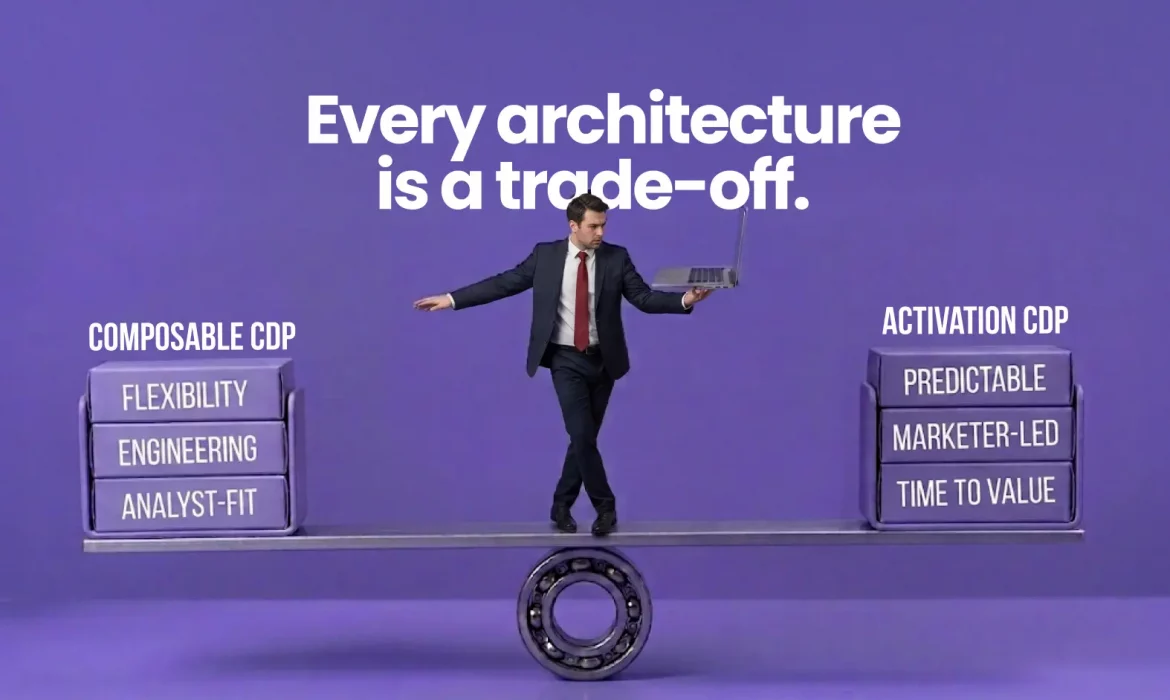
TL;DR: Packaged vs composable CDP isn’t a question of which is more sophisticated. The two solve for different constraints: composable serves teams with a working data warehouse and dedicated engineering capacity who need modeling flexibility, while activation-centric packaged CDPs serve teams whose bottleneck is marketing waiting on developer tickets to launch real-time, cross-channel campaigns. Neither approach is the default correct one, the right architecture depends entirely on which constraint is actually yours.
“Packaged vs. composable CDP.” We get asked this question often. On sales calls, in evaluation conversations, and sometimes from existing customers who’ve just read an article about composable CDPs and want to know whether they made the wrong call.
CDPs dropped from 26.9% to 17.4% as the center of B2C martech stacks in a single year. That reads like displacement, but a survey of CDP vendors found the largest group, 45%, still runs “mostly packaged with some composable.” CDPs have been squeezed from two sides: warehouses rising at the data layer, customer engagement platforms rising at the activation layer.
Here’s our position before anything else: Netmera isn’t a packaged CDP in the traditional sense. Netmera is a customer engagement platform with an activation-centric CDP built in.
Below, we’ll offer an honest read on Composable CDP vs CDP, where composable wins, where it strains, what CEP with data platform layer solves, and a framework to decide.
What is a composable CDP and what it requires
Definitive guide on composable CDP components by Arpit Choudhury and Glenn Vanderlinden remains one of the clearest breakdowns available: “A composable customer data platform is a set of integrated tools assembled using open-source or proprietary software to perform some or all functions of a packaged CDP.”
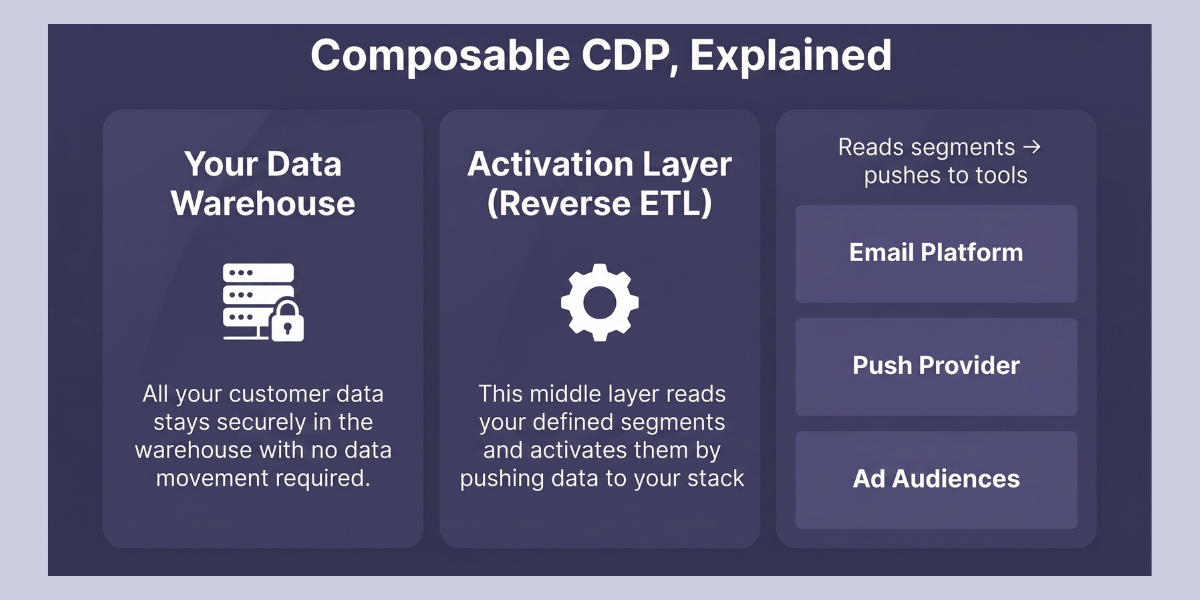
That means data stays in the warehouse. A reverse ETL tool or activation layer reads from it and pushes segments to downstream tools such as email platform, push provider, and ad audiences.
What it requires to function:
• A cloud data warehouse that already exists and is actively maintained
• Reliable event pipelines feeding clean, timely data into that warehouse
• Data engineering capacity to build and sustain the activation layer
• Stakeholders with enough SQL fluency to create and update audience models.
What it gives in return, when those prerequisites are met, is real: architectural flexibility, data ownership without vendor duplication, and, for teams with custom data models or complex multi-entity structures, the ability to build what the business needs.
Packaged CDPs: Built to store, or built to act?
Data-centric packaged CDPs are built primarily for unification, modeling, and audience syndication. They’re strong on centralized storage, complex segmentation logic, and analytics integrations. They don’t have native CDP activation. Which means, to run a campaign, teams integrate separate messaging and analytics tools.
Activation-centric packaged CDPs ingest, collect and unify data but also are optimized for what comes next: turning behavioral and demographic signals into cross-channel journeys from within the same system. Identity resolution, real-time segmentation, campaign launch, and consent management are part of one operational layer.
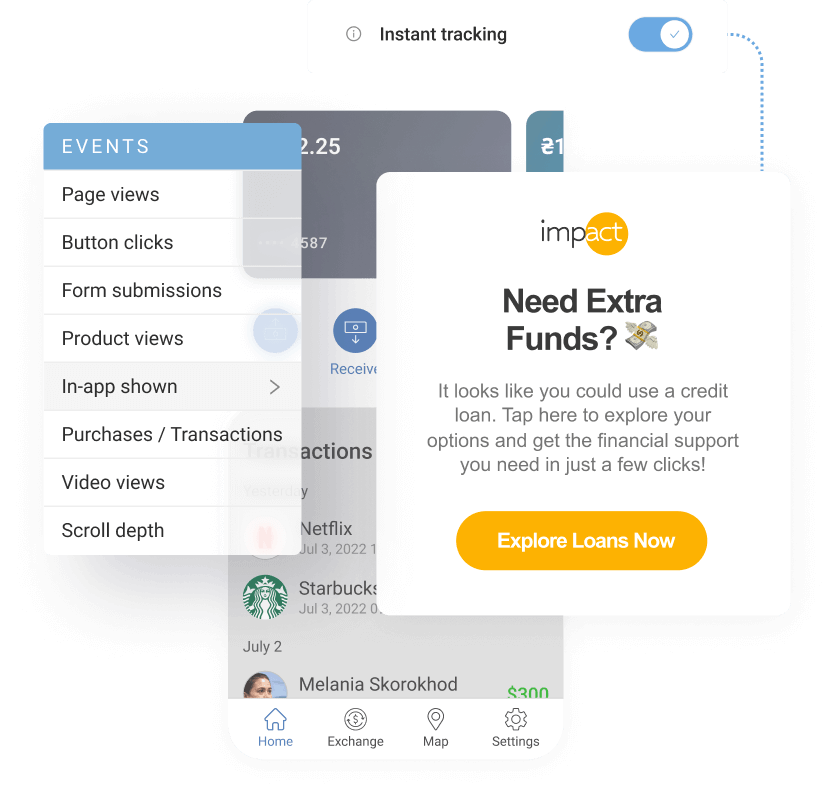
Netmera is a customer engagement platform, coming with an activation-centric CDP.
✓ Behavioral data collection via SDK, Tagless Data Capture, REST API, and panel uploads
✓ Unified customer profiles that update in real time across mobile, web, and backend sources
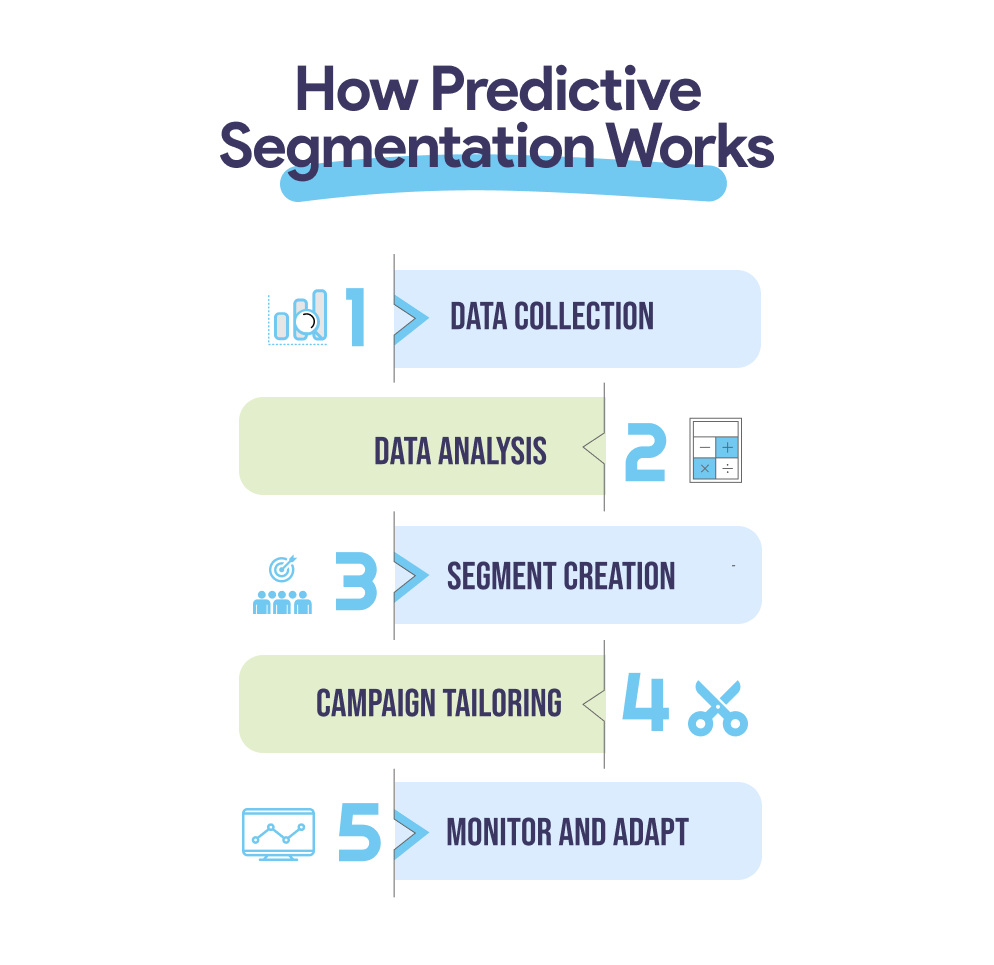
✓ Predictive segmentation powered by AI models that run nightly on behavioral signals
✓ Cross-channel execution across push, in-app, email, SMS, and WhatsApp
✓ Analytics and revenue reporting in a single dashboard with AI insights
Netmera is not a data warehouse and doesn’t replace one. Teams that need enriched event data flowing into Snowflake, Redshift, or S3 for cross-team analytics or ML workflows can stream it there directly through Netmera’s AWS Kinesis integration, alongside REST API and FTP for batch sync. The warehouse handles long-term analytical storage; Netmera handles real-time activation. Data ownership doesn’t require choosing one system over the other.
The CDP Institute’s definition of a CDP requires three conditions: a marketer-controlled system, a unified persistent database, and accessibility by other systems. Activation-centric data platforms meet all three while adding the execution layer data-centric platforms leave to other vendors.
A warehouse stores. An activation platform acts.
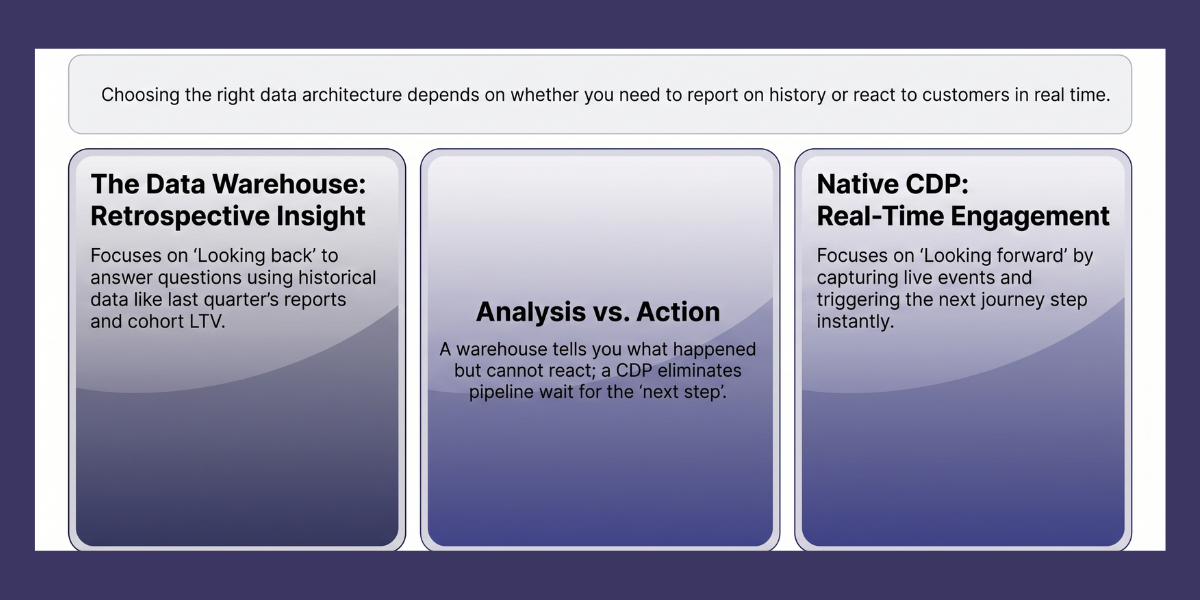
The CDP vs. data warehouse is another question that comes up often, and the answer is, actually, quite simpler.
A data warehouse stores, queries, and analyzes. It tells you what happened last quarter, which cohorts have the highest LTV, where users dropped off in a funnel. What it cannot do is react. A warehouse can’t, by design, detect that a user abandoned a cart 45 minutes ago and fire a push notification right now.
A CDP with native engagement capabilities is built for that moment. It captures behavioral events as they fire, updates profiles in real time, and triggers the next step in a journey without waiting for a pipeline to complete.
For example, when a user abandons checkout, the platform detects it, checks the user’s history and channel preferences, and triggers the next step in an automated journey, all within the same system. That’s CDP activation without the integration overhead.
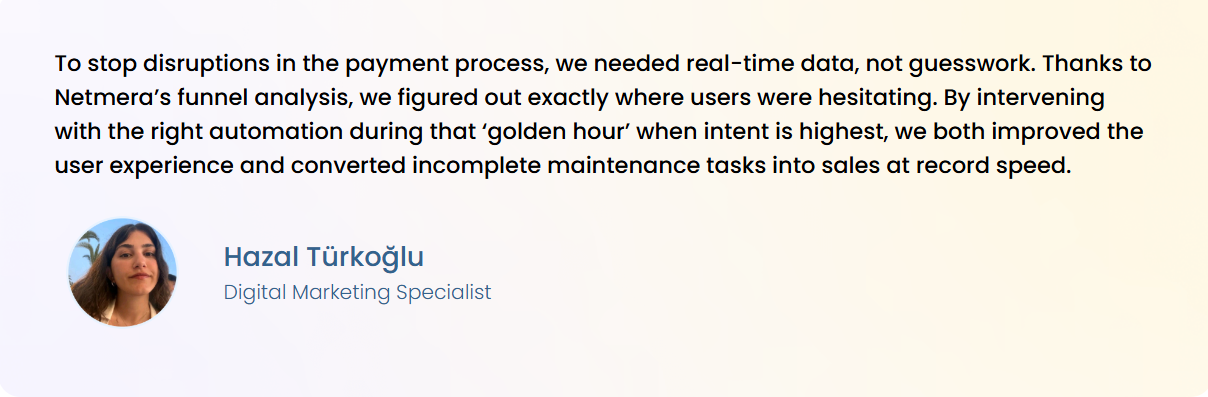
Case study: Fal Sepeti shows what that timing difference produces. When a user started checkout but didn’t complete a transaction within an hour, Netmera’s behavior-driven automation fired a push at the moment intent was still alive. Checkout-to-purchase completion rose from 30% to 56%, with 80% of users who clicked going on to finish their transaction.
3 conditions where a composable CDP makes sense
• Campaign activation and delivery is not the primary goal. When the main use case is centralized warehousing for cross-team analytics, ML model training, and internal data products, and campaign activation is secondary, composable gives data teams full ownership of the logic and structure.
• The data model is genuinely unusual. Complex B2B2C structures, multi-brand hierarchies with shared customer identities, custom event taxonomies no vendor has anticipated.
• Stable data engineering capacity exists. Specifically:
A dedicated team of engineers owns the integration layer
That team is not a single point of failure
Ongoing pipeline monitoring, schema management, and connector updates are owned.
According to cdp.com’s analysis, composable stacks typically require three to five dedicated engineers to maintain warehouse modeling, identity resolution, sync monitoring, and connector upkeep. A staffing cost that doesn’t appear in any license comparison.
When these three conditions are in place, composable may be the right call.
Who should think twice before going composable
The 2025 MarTech State of Your Stack Survey found that 65.7% of marketers name data integration as one of their biggest stack management challenges. The composable architecture, for all its data-ownership appeal, often compounds this problem rather than resolving it.
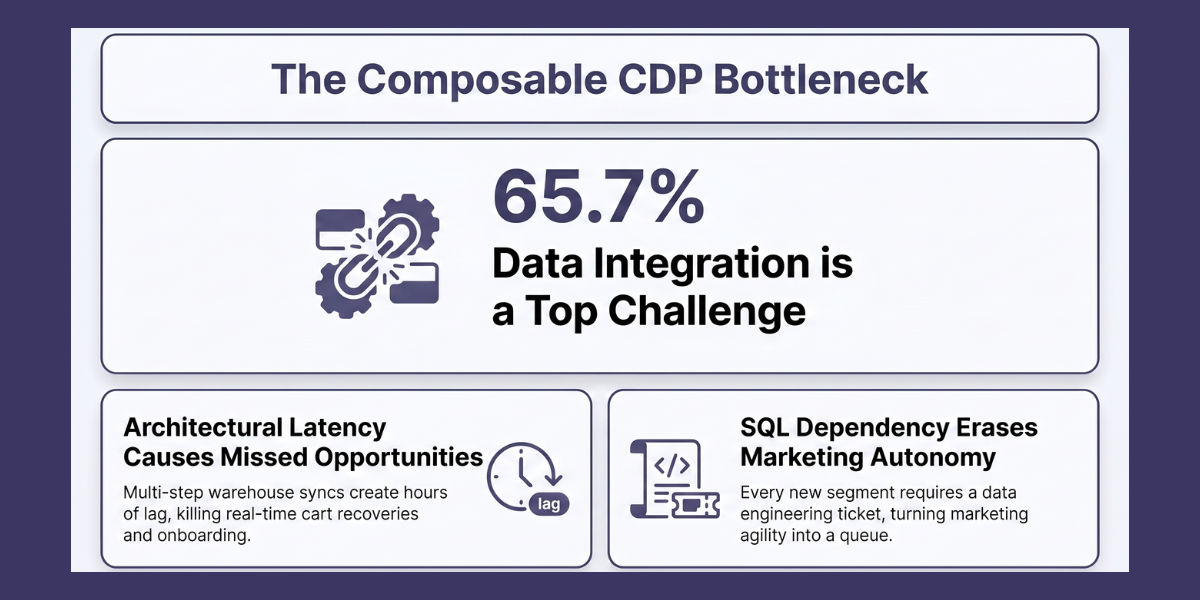
Latency. Data moves from your app to the warehouse, gets transformed, then travels through a reverse ETL tool before reaching a messaging platform. Complex warehouse implementations average 7.2 months before they’re operational, and that’s before runtime lag enters the picture.
Once live, total delay is measured in hours. This shows up in cart abandonment recovery rates, in churn intervention windows, in post-install onboarding sequences where day one is critical. Martech consultant Matthew Niederberger points out that a slow activation fix for time-sensitive triggers usually means building a separate real-time pipeline, which sits outside the composable stack itself.
SQL as the segmentation bottleneck. Every new audience, every new attribute a marketer wants to use requires a data engineering ticket. As Niederberger puts it, “if audience creation routes through the data team, your campaign calendar now runs on their backlog.”*
The vendor lock-in objection deserves the most attention here, because it’s the dominant argument cited in favor of composable.
A composable stack locks teams into SQL models written by engineers who are maybe not there now, dbt transformations that only one person understands, and a pipeline architecture that’s genuinely hard to audit or migrate. That’s lock-in too, distributed across internal technical debt rather than one vendor contract.
Who specifically owns the integration layer, and what happens when that person leaves? If the answer comes with hesitation, that is telling you something.
Every reverse ETL sync also copies customer PII, names, emails, phone numbers, into another vendor’s system. More copies mean more SOC 2 audit surface, slower breach scoping under GDPR’s 72-hour window, and legal overhead across five to eight systems that never shows up in a composable proposal.
*Niederberger isn’t arguing against composable in his article. He underlines that one architecture may fit some teams and not others. Rather than assess vendor pitches on architecture and feature list alone, teams, in his view, need to know their own needs and internal resources first.
Packaged vs composable cdp: how to decide
Conditions pointing toward composable:
• A working, actively maintained cloud data warehouse already exists
• A dedicated data engineering team (at minimum three to five people) owns and can sustain the integration layer
• Activation use cases are relatively simple or served by existing integrations
• Data modeling flexibility and governance ownership outweigh speed-to-campaign as priorities
• The primary audience for data outputs is internal analytics and ML teams, not marketing, CX, and product teams.
Conditions pointing toward activation-centric packaged CDP:
✓ Marketing and product teams need to build segments, launch journeys, and read analytics without SQL or developer tickets
✓ Real-time or near-real-time triggers matter: cart abandonment recovery, post-install onboarding, churn signals, behavioral events for CDP for ecommerce teams
✓ Channel delivery (push, email, SMS, in-app, WhatsApp) needs to be coordinated across one system
✓ No mature warehouse exists, or the one that exists was built for reporting rather than activation
✓ Speed to campaign matters more than architectural purity.
Setup costs for a full-scale data warehouse run $200K–$750K before licensing, with 15–20% annual maintenance on top. A third of SMEs have delayed adoption because of it. Their data reality is product events in one tool, CRM data in another, and no single place where customer identities are resolved.
Composable CDP narratives typically start from a data warehouse that exists and works. Most B2C teams start from customers who need engaging today.
What a packaged CDP looks like when activation is built in
62.1% of respondents report using more tools than two years ago. Adding a composable layer to an already fragmented stack frequently compounds the integration burden it was meant to solve.
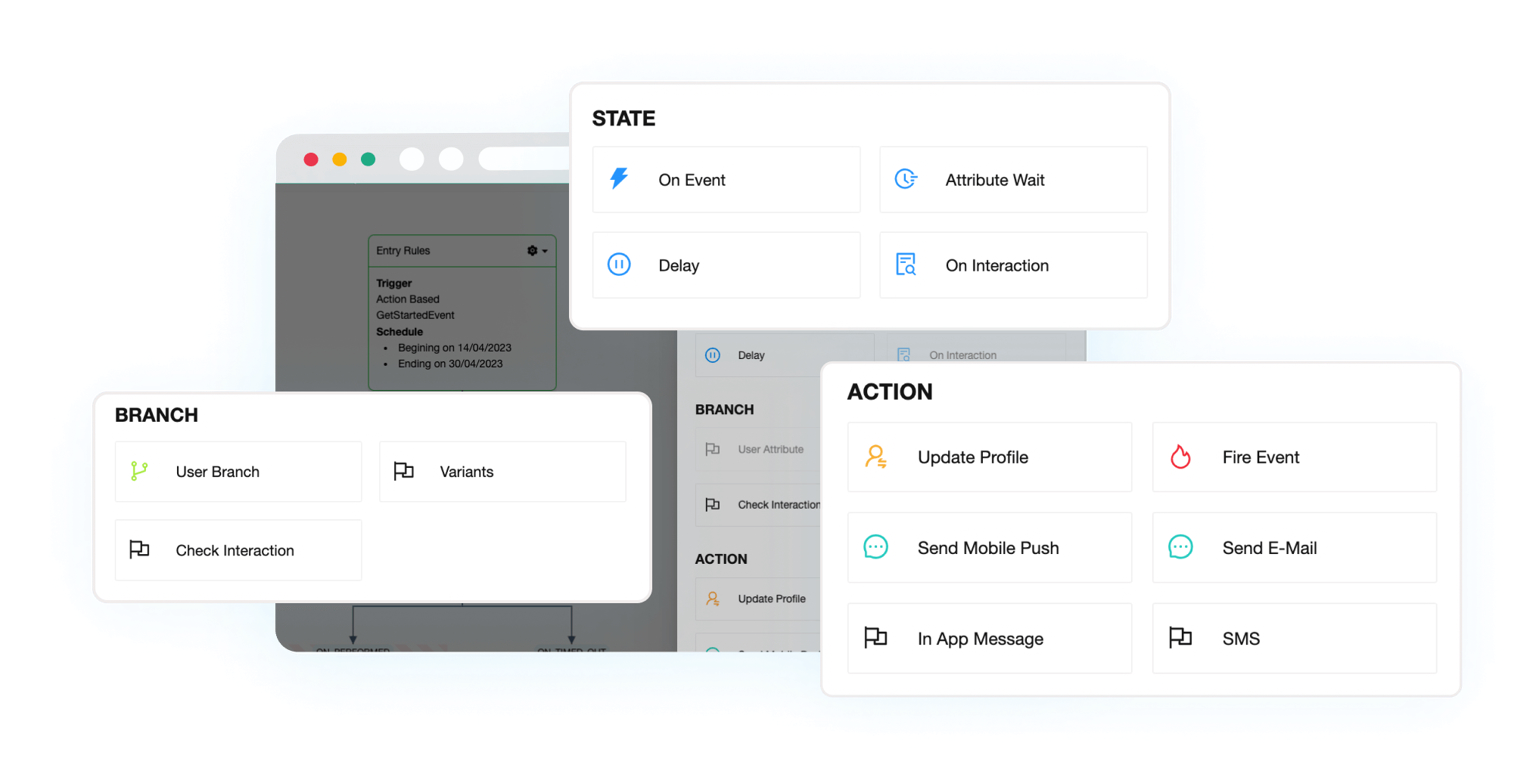
With Netmera, teams build segments from behavioral and predictive data, design multi-step journeys, and launch across push, email, SMS, WhatsApp, and in-app from one platform, without SQL queries or developer tickets. The data layer and the activation layer are the same system.
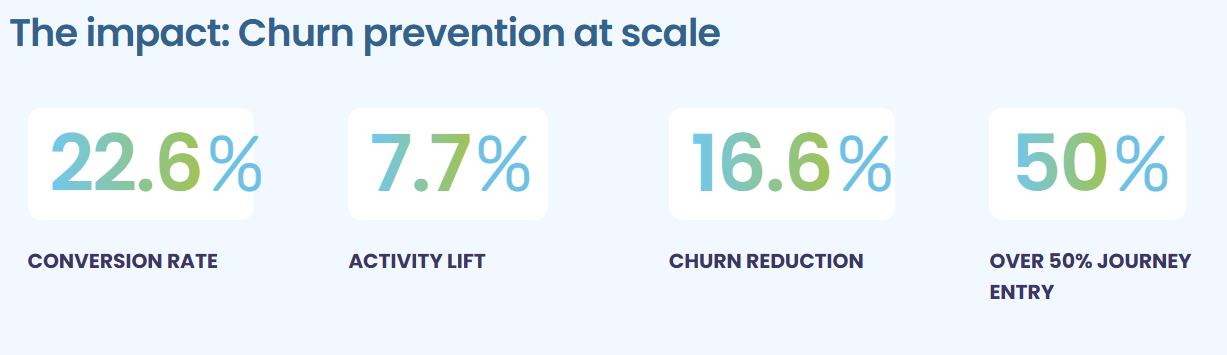
Case study: UPTION shows what that unified layer makes possible at scale. Using Netmera’s predictive churn prediction alongside Journey Builder, they identified thousands of at-risk users across three languages and ran an automated recovery sequence without involving their development team. The churn segment shrank 16.6%. Among users who entered the journey, 22.6% converted.
In Netmera, collection starts once the SDK is integrated:
✓ App installs, session starts, time in app, and push receipts are collected automatically
✓ Tagless Data Capture tracks screen views, button taps, and scroll depth without manual tagging
✓ Custom events for product-specific actions require brief developer input once; after that, the behavioral layer runs on its own.
✓ Ingestion brings in what already lives in your systems:
✓ FTP integration for scheduled, automated file transfers from data sources
✓ REST API for event ingestion and profile updates from existing pipelines
✓ CSV uploads through the dashboard for bulk profile updates and consent imports
✓ Third-party connectors (Adjust, google analytics, and others) for attribution and install data
If you’re evaluating whether Netmera fits your team’s conditions, setup takes weeks. See how it works in practice.
Name your bottleneck first. The architecture decision follows.
It is 2026 and AI is everywhere. Every predictive score, send-time optimization, and behavioral trigger your engagement platform runs can only fire on data that’s unified, clean, and current.
Jacques Corby-Tuech made this point in his great article: brands that skipped their CDP investment a few years ago are finding out now that the absence of that layer is what’s keeping them off the AI capabilities they want. The data foundation and the AI layer aren’t separate decisions.
If data control and modeling flexibility are your constraint, composable CDP is a serious option. Treat the prerequisites honestly: the warehouse, the engineers, the ongoing maintenance.
If marketing autonomy and real-time activation are your constraint, an activation-centric packaged cdp solves a different problem that composable cannot reach without significant internal build effort.
Netmera is one example of what activation-centric looks like in practice: behavioral data collection, unified profiles, predictive segments, and cross-channel journey execution in one platform.
Get in touch with our team to map your activation gaps and see what a unified approach would look like for your channels and data.
FAQ on choosing between composable cdp and packaged cdp
A composable customer data platform keeps your data in an existing cloud warehouse like Snowflake or BigQuery. Instead of copying data into a vendor’s proprietary storage, a reverse ETL layer reads from the warehouse and pushes segments to downstream tools for messaging, ads, and analytics.
The core difference is where the work happens. A composable CDP keeps data in a warehouse and routes activation through a separate layer. A CDP with native activation handles both in one system. For B2C teams running behavioral triggers, cross-channel journeys, and real-time segments, the pipeline lag in a composable setup creates gaps that packaged activation platforms don’t have.
A traditional CDP bundles data collection, unification, and activation in one system. A composable CDP separates those layers: your data stays in a cloud warehouse, and you connect activation tools on top via pipelines. Traditional CDP gives marketing and product teams direct access to segments and campaigns. Composable stacks route most of that work through data engineering.
Not sustainably. A production composable CDP deployment requires at least three to five dedicated data engineers for ongoing operations such as pipeline monitoring, schema updates, connector maintenance, and debugging sync failures. Without that capacity in place, the activation layer degrades as data models drift and pipelines break.
If your frustration is that data ownership is fragmented across vendor silos and your warehouse team can’t get clean signals, composable may solve it. The conditions that point toward composable are a working warehouse, stable engineering capacity, and activation needs that are relatively simple.
Yet, if your team’s primary frustration is that marketing can’t access or act on customer data without filing engineering tickets, composable deepens that dependency.
The conditions that point toward an activation-centric packaged CDP are real-time trigger requirements, channel coordination across push, email, SMS, and in-app, and a marketing team that needs to move without developer involvement.
No. Some B2C companies run a warehouse for analytics and reporting alongside a packaged activation platform for campaign execution. The warehouse answers historical questions like cohort LTV, funnel drop-off over time, and ML training data. The activation platform responds to what users are doing right now. These are different jobs, and a platform like Netmera keeps both in sync: REST API and FTP handle batch integration, and an AWS Kinesis connection streams event data into the warehouse in real time as it’s generated.
Burcu Ulucay – Content Marketing, Netmera