How to evaluate an omnichannel marketing platform: Six questions to ask
Last update: July, 2026
TL;DR: Evaluating an omnichannel marketing platform is harder than it looks when every vendor describes their product the same way. Six questions in this post help you get past the demo and into what actually matters: native customer data unification, marketing autonomy from IT, predictive segments that feed into journeys, built-in channels, revenue-connected reporting, and how fast you can go from a new segment to a live campaign. Each question comes with red flags worth catching before you commit.
76% of businesses are investing in omnichannel engagement technologies to meet customer channel preferences.* The omnichannel marketing platform category is, unsurprisingly, getting more crowded. The promises are similar, and the word “omnichannel” appears in almost every vendor’s positioning whether they’ve earned it or not.
The six questions in this post come from a specific place: what our sales and onboarding teams consistently hear from marketing and CX teams switching from fragmented stacks to a unified platform.
A note before we go further: multichannel marketing has its place. A brand entering a new market or vertical with limited data needs effective multichannel messaging. We covered when to choose multichannel over omnichannel (or vice versa), and how to make the switch, in a separate post.
We’ll start with a bit of background first, so if you’re already at an evaluation stage, jump straight to section “How to assess any omnichannel marketing platform: Six questions to ask”.
*Source.
Multichannel vs. omnichannel marketing platform: Key differences explained
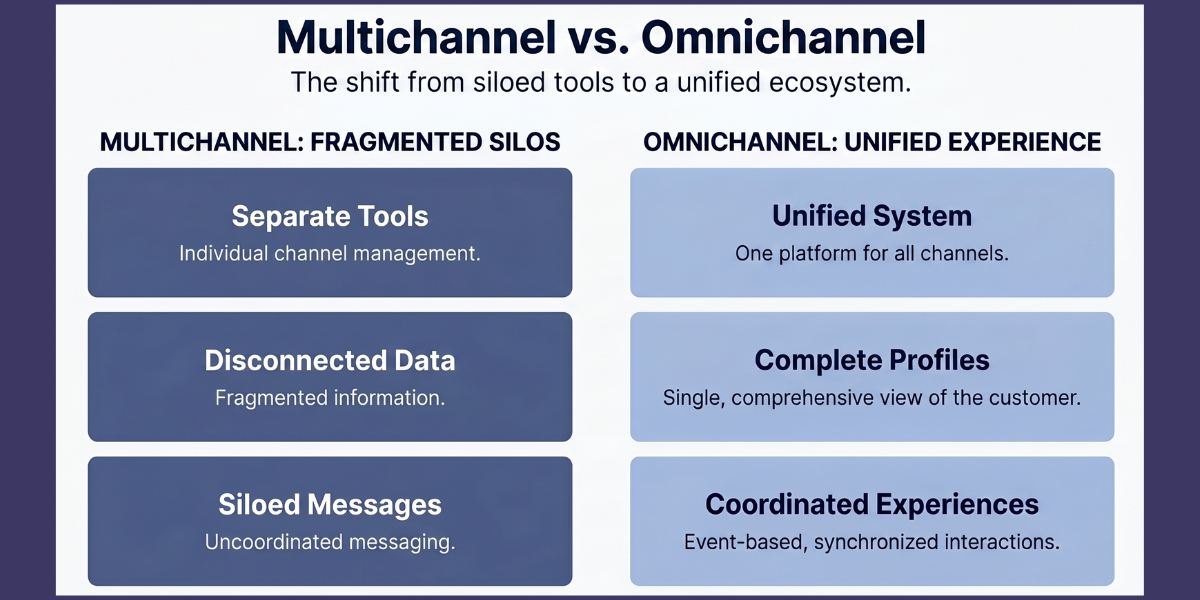
Multichannel means separate tools per channel with disconnected data. One platform for email, another for push notifications, a third for SMS and so on. Each stores its own customer records.
Omnichannel platforms, on the other hand, unify those profiles and coordinate event-based experiences across every channel from one system.
The cart abandonment example makes the omnichannel vs multichannel difference concrete.
A customer leaves their cart at 2pm. In a multichannel setup, your email tool does not see the event. Push uses a different user ID. SMS still needs a manual list upload. The user is often out of the purchase flow before any channel catches up.
On an omnichannel platform, that single event triggers a sequence. Push notification within 30 minutes. If the user purchases, the journey ends and the conversion is attributed. If not, email with product details follows after five hours, then SMS the next morning. Users who complete the sequence without buying exit into a separate segment for future re-engagement.
Shoppers want that experience. They favor coordinated cross-channel marketing, and are 17 times as likely to find those messages helpful, compared to shoppers who experience uncoordinated messaging.
(If you want a deeper look at what omnichannel marketing means, check out this evergreen article from McKinsey.)
Modern customer engagement depends on real-time reactions. Pricing page visits, repeat app sessions, or stalled checkouts demand instant action and consistent messaging across app, web, email, WhatsApp, and SMS.
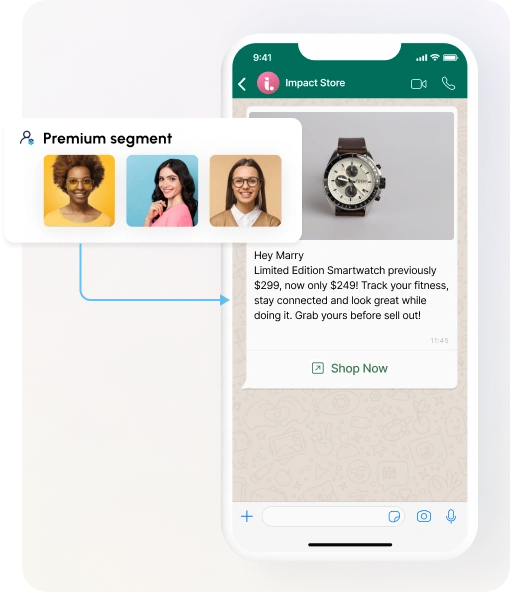
Netmera brings these functions into one omnichannel marketing platform where behavioral data feeds segments and triggers in real time. Teams launch cross channel experiences instead of managing channel silos.
Core capabilities every omnichannel software should deliver
If a platform claims to be omnichannel, it should deliver these specific capabilities: unified customer data, real-time behavioral triggers, automatic tracking, cross-channel journeys, app and web engagement together, and analytics that tie activity to conversion.
Unified customer data without a separate CDP
Every channel contributes to one user profile. A person who browses on mobile, adds items on desktop, and clicks an email still appears as one journey. Platforms like Netmera include an integrated CDP, so teams don’t maintain separate data infrastructure or stitch events manually. If your evaluation includes a composable option, a data warehouse with a reverse ETL layer on top, when that setup makes sense and when it doesn’t is covered in this post.
Real-time triggers and predictive intelligence
Behavioral triggers fire the moment someone abandons a cart, views pricing pages repeatedly, or shows early churn signals. Predictive intelligence works a layer deeper: AI segments identify who is likely to churn or convert before they act, and optimal send-time calculations ensure messages reach them during their highest-engagement window.
Automatic event tracking without IT tickets
Every screen view, tap, and product interaction is captured instantly, which eliminates tagging cycles and waiting for developers to release new events. Netmera’s tagless data capture, for example, makes behavioral data immediately available for segmentation and campaigns.
Cross-channel journeys from one builder
One workflow controls push, email, SMS, WhatsApp, and in-app messages with conditional logic. If a user ignores push, email triggers. If they purchase, the journey stops and revenue attribution completes.
Mobile and web engagement in one system
“Today, the buyer’s journey is increasingly nonlinear, reflecting the complexities of consumer behavior today,” argues The Agile Brand Guide. Their team outlines five strategies for managing these nonlinear journeys, starting with one you’ve probably guessed: embracing omnichannel marketing.
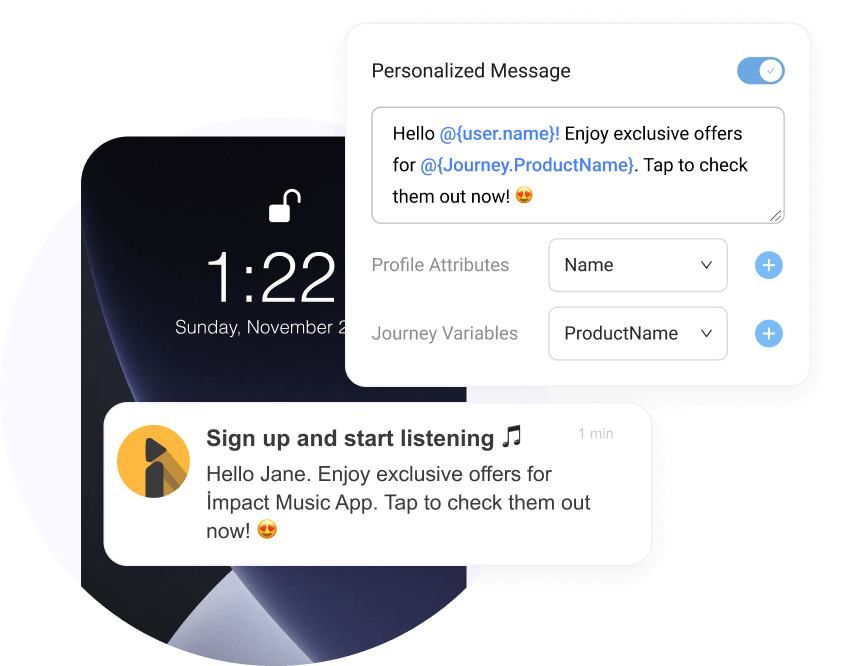
App push, web push, in-app messages, popups, emails, SMS and WhatsApp all run from a single profile in omnichannel software like Netmera, so even as customers move unpredictably between channels, each session builds on the last and maintains context throughout the journey.
Revenue analytics instead of surface metrics
Surface metrics do not prove ROI. Ten thousand opens mean nothing if they do not convert. Funnel-level revenue reporting shows where customers drop off and how much revenue each step generates.
Six questions to ask before assessing any omnichannel marketing platform
Finding the best omnichannel software means going past the vendor deck and into the mechanics. The six questions below work as an evaluation framework for any platform you’re considering, including us. We’ll show how Netmera answers each one, but the questions are the useful part. Take them into every demo you run.
Question 1: Does this omnichannel solution include customer data unification or require a separate CDP?
Teams often ask which CDP supports omnichannel campaign targeting without a separate implementation. The short answer: unified platforms that include a native CDP for data collection, segmentation and activation.
In such settings, behavioral events from apps and websites flow into unified profiles. This data lets brands make informed marketing decisions. CRM and backend data connect automatically, so teams access complete customer records in real time.
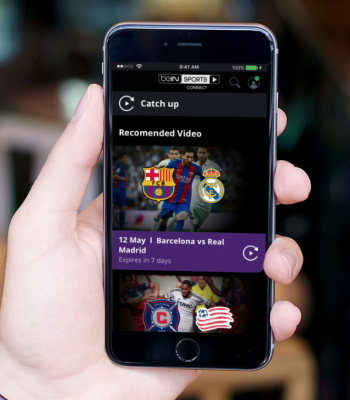
A streaming platform facing churn consolidated their data in Netmera. They segmented users by behavior and triggered automated push and email campaigns for both active and lapsed subscribers. New subscriptions tripled, retention improved, and users explored more content.
We break this down in our blog post, comparing standalone CDPs with engagement platforms that bring data, messaging, and analytics together. Here is the link if you want the full picture.
Red flags: Vendors that require a separate CDP, rely on “integrations” without native collection, or demand manual tagging for each new event. Ask in the demo: Show me how a new behavioral event from our app appears in a user profile, without us writing any tracking code.
Question 2: Can marketing run campaigns without IT support?
A no-code journey builder puts full control in marketers’ hands. Real-time behavioral data feeds unified profiles, so segmentation, journey planning, and cross-channel campaigns happen without delays. Push, email, SMS, and in-app messages run in sequence without relying on developers.
UPTION, a fintech app for international money transfers, needed to reach thousands of at-risk users across three languages without involving their development team. Using Netmera’s Journey Builder, they launched a 10-message recovery sequence with branching logic that stopped the moment a user returned. The churn segment shrank 16.6%, and 22.6% of users who entered the journey converted.
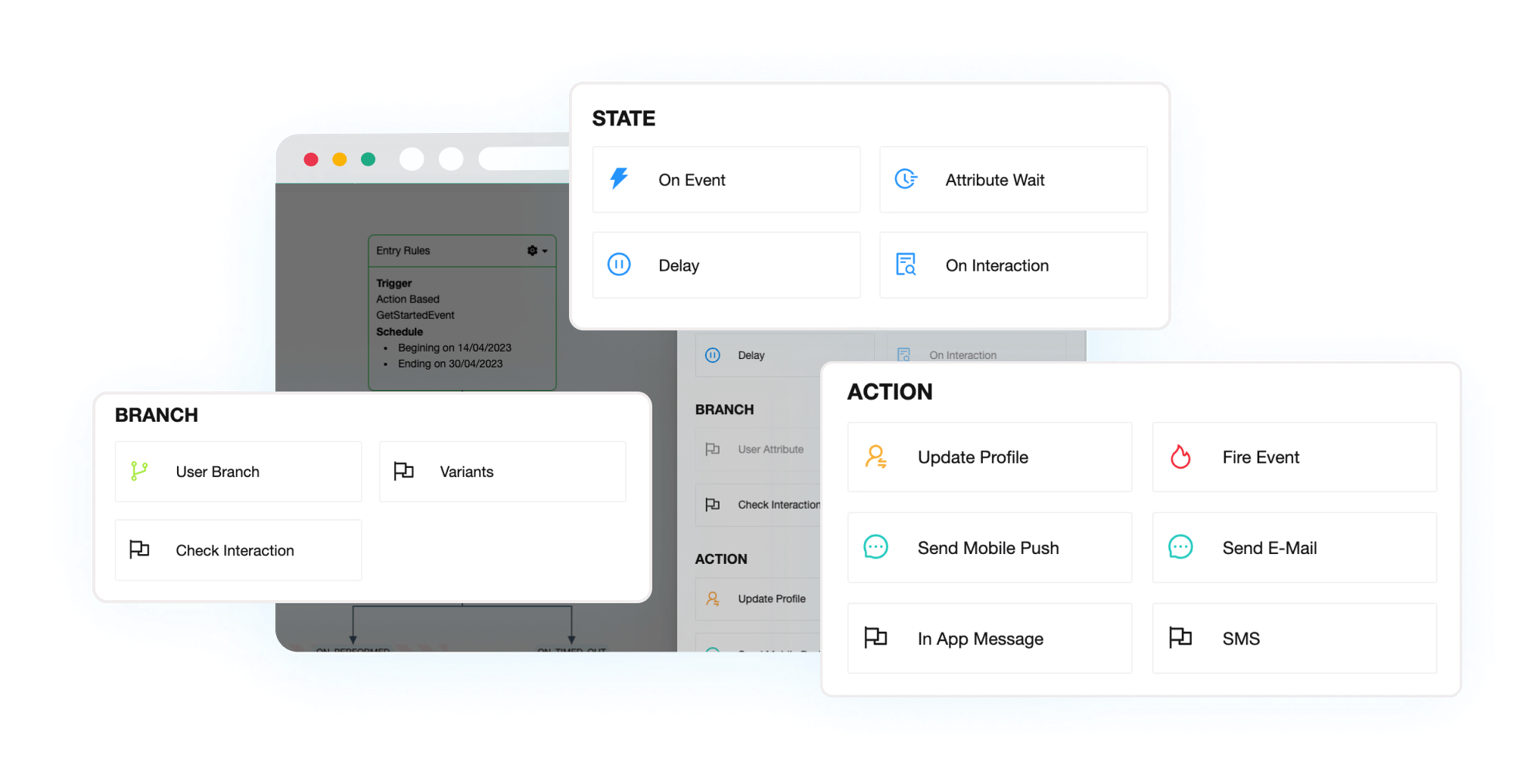
In our blog post, we show how brands use Netmera’s no-code journey builder to run automated, personalized campaigns from onboarding to reactivating users or recovering carts.
Red flags: Platforms that require developers for campaign logic, SQL for segmentation, or IT approval for updates. Ask in the demo: Build a segment and launch a campaign right now, in front of me, without involving a developer.
Question 3: Does the platform connect predictive segments to omnichannel customer journeys?
AI-powered predictive segments identify churn risk and high-value purchase intent, feeding directly into customer journeys.
Picture an e-commerce store where AI spots customers who browsed premium products three times but haven’t purchased. The system predicts they’re 80% likely to convert within the next week.
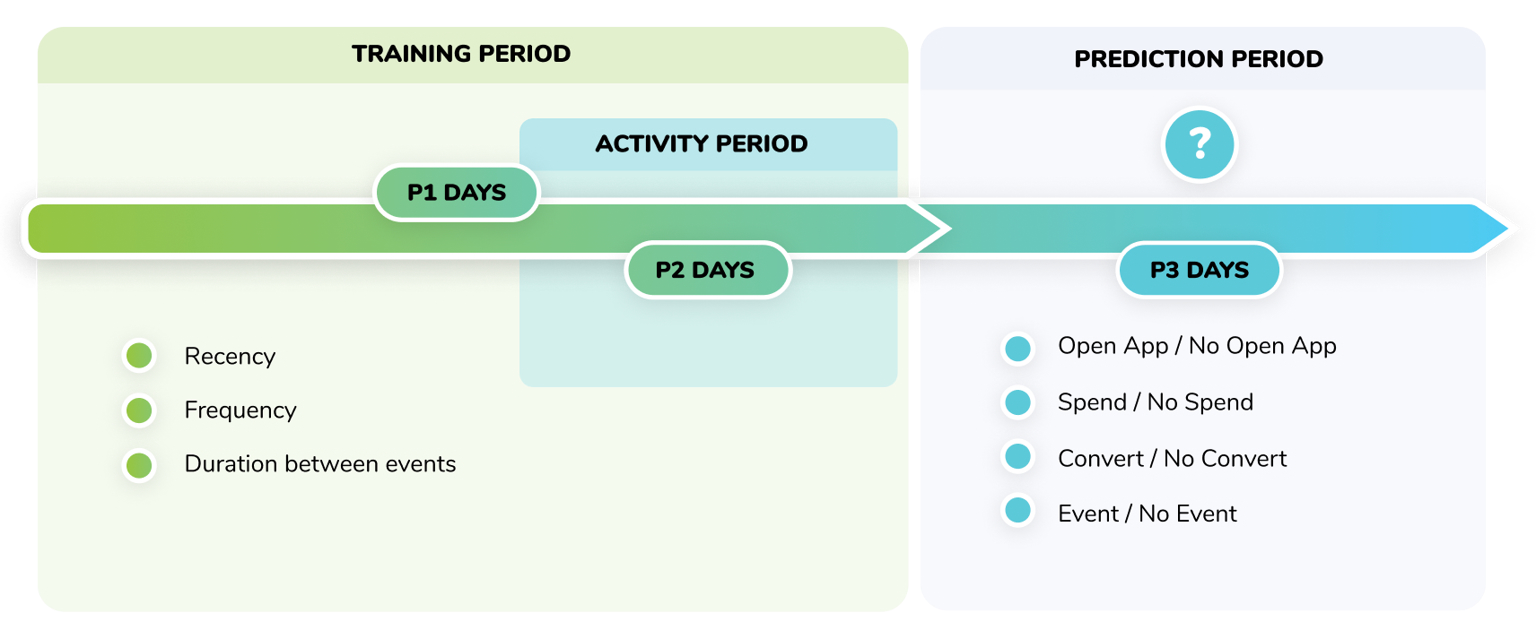
Their marketing or product management team creates an automatic journey flow with Netmera:
AI spots the signal → an email featuring the exact products they browsed arrives in their inbox → no purchase after 24 hours → a push notification with a limited-time discount lands at their peak engagement window, calculated from 60 days of activity.
The marketing team can draft the email copy in their AI tool through Netmera’s MCP server, keeping the message on-brand without switching platforms.
In our blog post, we explain how Netmera AI predictions power personalized, well-timed campaigns across every step of the journey. Take a closer look.
Red flags: Insights that don’t trigger campaigns, uniform send times, inflexible prediction windows, no control over precision. Ask in the demo: Show me a predictive segment automatically entering a live journey, not a manual export, an automatic trigger.
Question 4: Does the omnichannel messaging platform include native channels or just integrations?
Omnichannel customer engagement platforms provide all channels your marketing needs: push, email, SMS, Live Activities, WhatsApp, in-app messages, web popups, and geofencing work from a single platform. WhatsApp is a growing part of omnichannel WhatsApp strategies in retail and financial services, especially in markets like MENA where messaging app adoption is high.
With a no-code Journey tool, you can handle automated campaigns across channels instead of planning each separately.
Red flags: “Integrations available” for core channels. WhatsApp requires a separate platform. Geofencing as a paid add-on. Channel-specific dashboards instead of unified reporting. Ask in the demo: Run a journey that branches across push, email, and in-app from a single workflow. Show me the actual builder.
Question 5: Does reporting show financial impact or just engagement metrics?
A real omnichannel customer experience solution sends messages across channels and it tracks what happens after each message. Open rates tell you very little (if nothing) about purchases. You need funnel visualization that shows exact abandonment points tied to revenue loss.
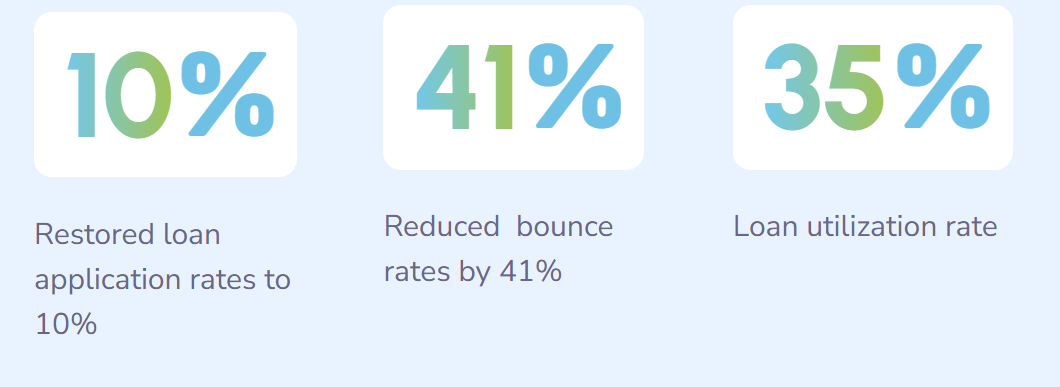
DenizBank spotted a 50% drop-off in loan applications through this kind of analysis. Android users with outdated devices couldn’t view contracts due to loading issues. Once they fixed the technical problem and retargeted affected users, conversion rates jumped back to 10%, bounce dropped 41%, and loan utilization hit 35%.
When you use Netmera, these insights appear in real-time dashboards that track revenue per journey step. Financial KPIs like average revenue per user, app conversion rate, and hot conversions sit right there in the platform.
The Dashboard surfaces AI-powered insights on engagement and revenue across every channel, updated daily and monthly, without switching tabs. That’s how our customers connect every campaign to business outcomes.
Red flags: Reporting stops at delivered, opened, and clicked. No revenue attribution. Funnel analysis requires a separate analytics tool. Anomaly detection absent. Ask in the demo: Show me a campaign’s revenue impact. I mean, actual conversion value tied to a specific journey step.
Question 6: How quickly can you test new segments and launch omnichannel campaigns?
During calls with potential customers, one issue often comes up: teams struggle to keep pace with their users’ behavior. The time it takes to go from tracking user actions to segmentation, campaign launch, and monitoring often takes too long.
So, how does Netmera solve this?
After the SDK integration and onboarding is complete (which typically takes two weeks to two months depending on your app’s complexity) same-day launches become standard for basic scenarios.
Tagless Data Capture eliminates waiting for event tracking by automatically collecting the data. The drag-and-drop Journey Builder turns complex, multi-step engagement flows into minutes of work. A/B testing runs across in-app messages, push notifications and web pop-ups without forcing you to bolt on separate tools.
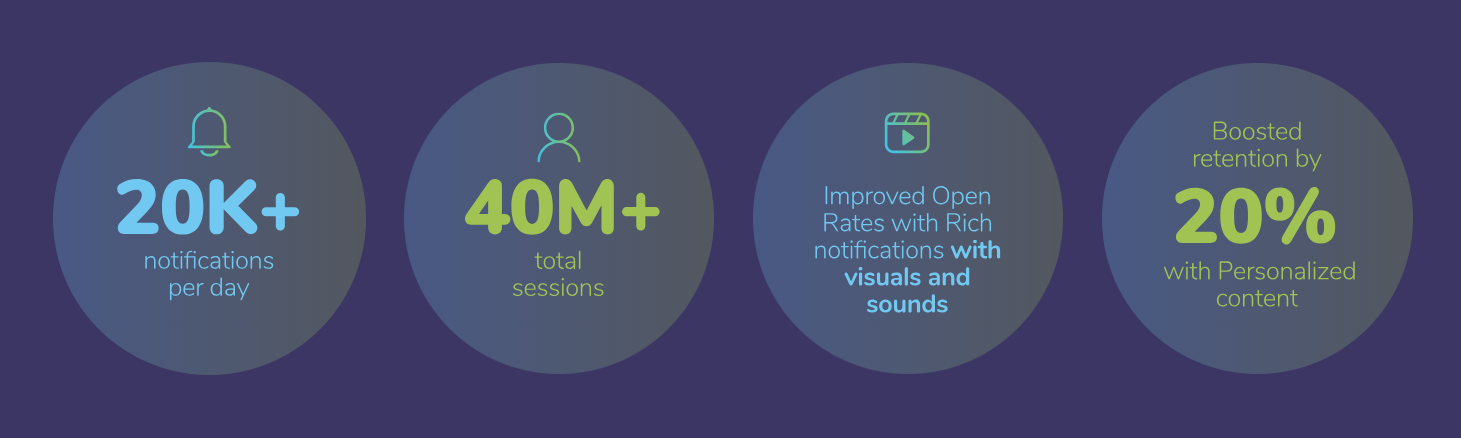
The platform’s scalability matches your users’ speed. Mackolik, for example, sends over 20,000 notifications daily, generating more than 40 million total sessions. By personalizing push messages based on user preferences, they saw retention climb 20%. Your customers set your rhythm, and your technology should keep pace.
Red flags: 2-4 week implementation for new tracking. Developer approval needed for campaign changes. A/B testing requires a separate tool. Channel updates need QA cycles. Ask in the demo: How long would it take to start tracking a new user event and use it in a campaign today? Walk me through the actual steps.
Elsewhere, we compared the top customer engagement platforms against three criteria: data unification, journey orchestration, and revenue analytics. Check the full comparison.
Practical actions to compare omnichannel marketing tools
We understand that as a digital marketer or product manager, you face many critical decisions. Evaluating omnichannel platforms is one of the more time-consuming ones, so here is a quick recap of omnichannel marketing best practices we have been sharing for years across various industries, including banking, telecom, travel, media, and e-commerce.
Personalized, coordinated experiences across channels come from eliminating handoffs between data collection, analysis, and activation.
Schedule a demo and see how Netmera works as a unified omnichannel marketing platform, with built-in data, no-code campaigns, and revenue-connected analytics in one place.
FAQs on choosing an omnichannel marketing platform
An omnichannel marketing platform unifies customer data and coordinates campaigns across all channels, including push, email, SMS, WhatsApp, and in-app messages, from a single system. Unlike multichannel tools that operate in silos, omnichannel platforms share behavioral data across channels so each message reflects what the customer just did, not just who they are.
Multichannel platforms deliver messages through multiple channels using separate tools with disconnected data. Omnichannel platforms consolidate those profiles into one system and coordinate event-based sequences across channels. The practical difference: a cart abandonment on your website triggers a cross-channel sequence in an omnichannel setup. In a multichannel setup, your email tool doesn’t see that event.
Not with platforms that include a native CDP, like Netmera. Built-in data collection means behavioral events from apps and websites flow directly into unified profiles without a separate implementation. Platforms that rely on integrations for data collection introduce sync delays, additional licensing costs, and IT dependency that slows campaign execution.
Yes, with platforms that include a no-code journey builder and automatic event tracking. Netmera’s Tagless data capture, for example, eliminates the need to file tickets for new event tracking, and its drag-and-drop Journey Builder lets teams configure conditional logic, timing, and channel sequencing without writing code.
Six things to check:
– Customer data unification is native to the platform, with no separate CDP required
– Marketing can launch campaigns without IT support
– Predictive segments feed directly into journey triggers
– Core channels are built in, with no third-party integrations filling the gaps
– Reporting connects activity to revenue, down to the journey step
– A new behavioral signal can become a live campaign within the same day
Platforms that clear all six are operationally omnichannel.
Beyond delivery and open rates, omnichannel analytics should show funnel drop-off by step with revenue attached, conversion rates per channel, journey-level revenue, and anomaly detection that flags unusual patterns in real time. Platforms that stop reporting at clicks cannot prove ROI and cannot tell you where campaigns are leaking.
Burcu Ulucay – Content Marketing, Netmera