Customer engagement during BFCM: what to do before, during, and after the sale
Last update: Oct, 2026
TL;DR
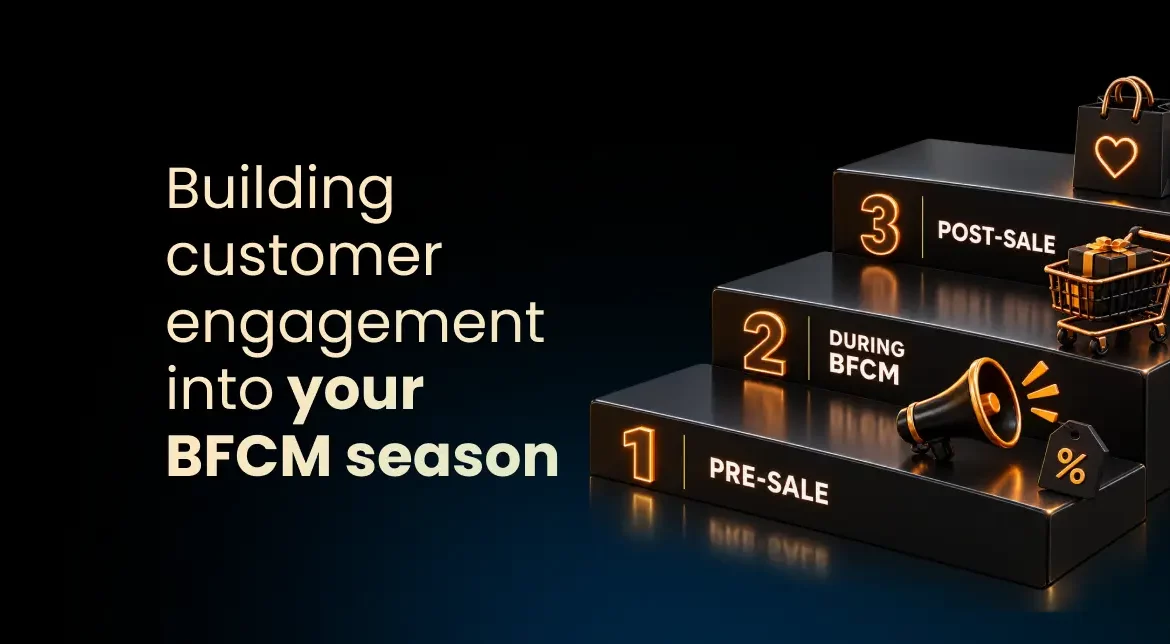
◆ BFCM strategy spans three stages: presale, during the sale, and post-sale.
◆ Presale is for segmentation, campaign ideas, and preparation.
◆ During the sale, teams launch cross-channel journeys, with exit, suppression, and frequency capping in place. More channels doesn’t bring more loyalty and revenue.
◆ Post-sale is for nurturing and keeping the brand and its products top of mind, mostly through email, with push, in-app, and WhatsApp as support.
◆ Brands can run successful BFCM campaigns when a customer engagement platform lets them unify customer data and deliver messages in one place. Managing several vendors instead means data sync and channel coordination can break.
◆ BFCM isn’t specific to ecommerce and retail. Sectors like financial services, telecom, and travel can be just as active, with examples further in the post.
That’s the time of year when marketers and CX teams start running into tactics for the BFCM (Black Friday Cyber Monday) season. Yet, BFCM needs a strategy first, and then tactics that support it. What makes a BFCM strategy hold up across the entire holiday season and beyond is strong customer engagement.
That means keeping customers engaged before, during, and after the sale, which depends on how accurate and fresh your first- and zero-party data is. That data comes from behavior inside the app, behavior on the web, and direct input through surveys and feedback.
56.4% of US online holiday transactions happened on a smartphone during the 2025 season, according to Adobe Analytics. eMarketer forecasts that mobile will deliver more than 70% of incremental online dollar gains in 2026, as its share of holiday ecommerce approaches 60%. Customers shop from mobile, and every mobile session is more data you can use to sharpen the next campaign.
Presale: segment and prepare while there’s still time
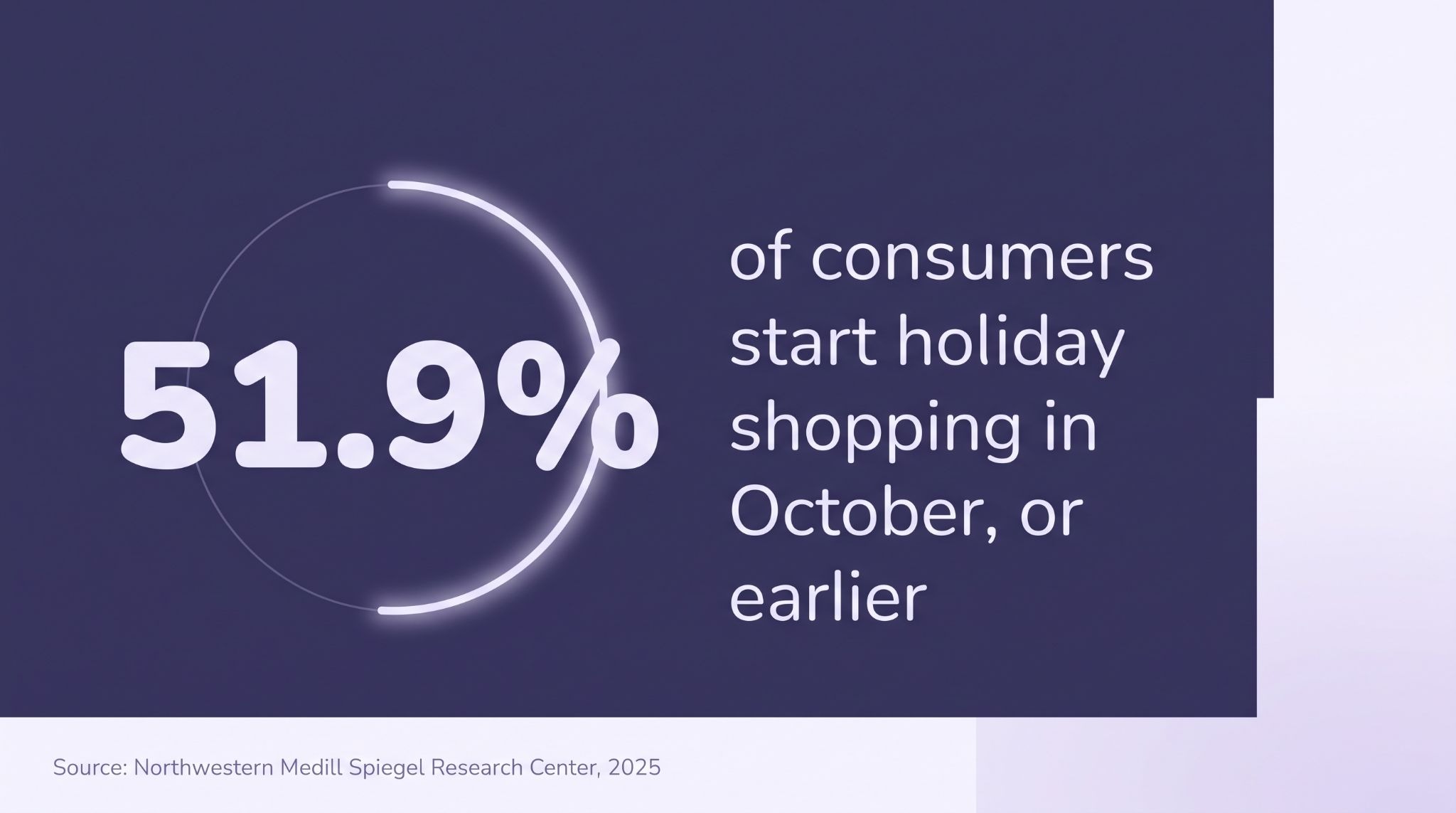
Over half (51.9%) of consumers begin holiday shopping in October or earlier. Brands need to prepare in advance, using their customer engagement platform to analyze data, segment audiences by behavior or with predictive AI, and lock in campaign details like timing, copy, frequency, message limits, and personalization, along with discounts and other incentives.
Discounts still work, but what shoppers count as “value” is shifting. Free shipping, exclusive bundles, and early access now outweigh a few extra points off in what people say gets them to buy.
When you get segmentation right, the rest of a BFCM strategy follows. Two primary kinds do the work.
Behavioral segmentation groups customers by what they’ve actually done: browsed the same category twice, added an item to cart without purchasing, or opened the last three promotional emails.
Predictive segmentation surfaces who’s statistically likely to buy, churn, or become a high spender before that behavior plays out, so a brand can act on the signal in advance.
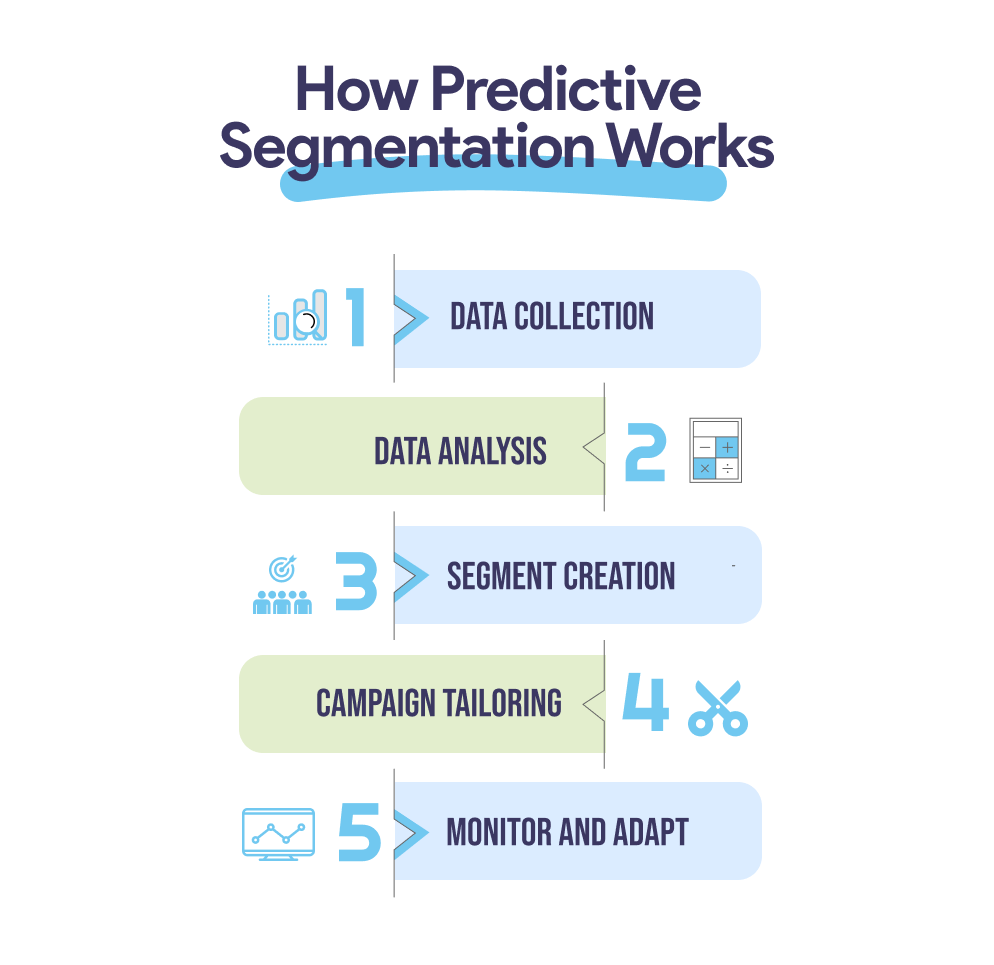
Prospects often tell us they’re running predictive analytics and messaging on separate tools, and once more than one channel is involved, that usually means three to five different vendors stitched together. Creating predictive segments and launching campaigns from the same platform is one of the first things they notice as they consider Netmera.
At this stage, marketing teams can also use Netmera’s MCP server to ask about their data, like which segments grew this week or how last year’s early-access campaign performed. From there, they can draft a first version of a BFCM campaign in plain language, then edit, approve, and send it to customers.
During BFCM
Automate cross-channel journeys: say less, more precisely
More touchpoints feel like more revenue and engagement. It isn’t, unless every channel is coordinated against the same view of the customer, with frequency capping and message limits in place.
Frequency capping sets a hard limit on how many messages go out per channel per day or week, regardless of how many trigger conditions a customer meets. Consent management keeps promotional messages on a separate track from transactional ones.
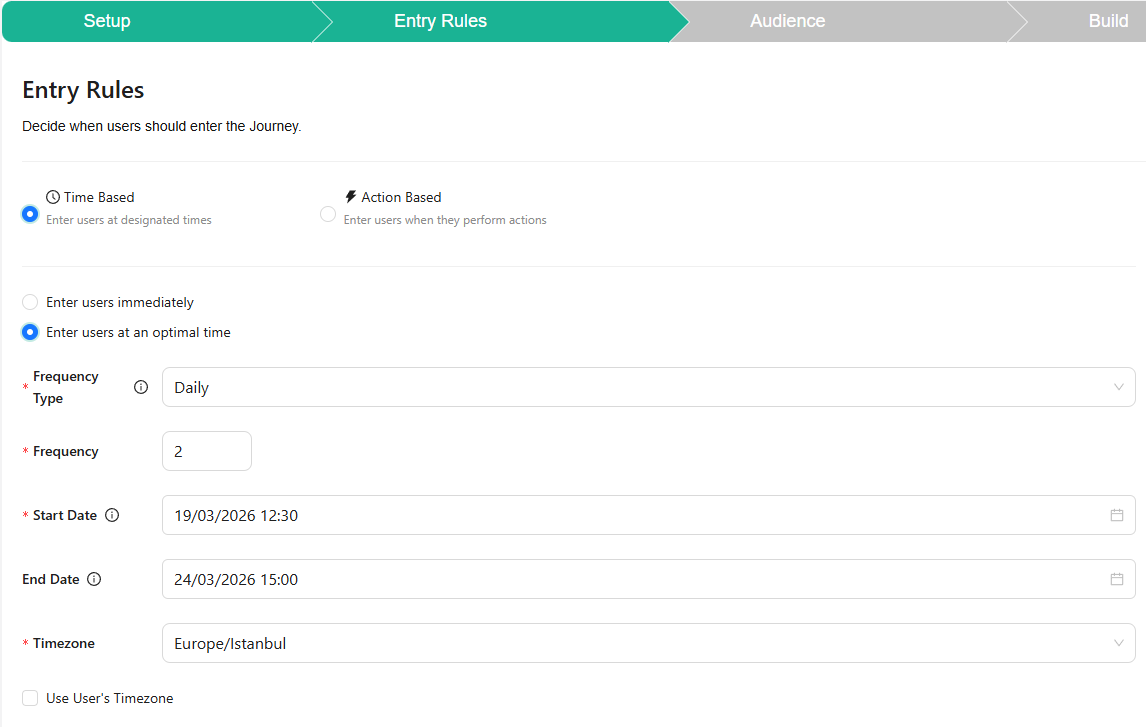
In Netmera, the frequency capping mechanism works per channel and campaign, or per journey with branching logic. Message categories let our customers act according to each user’s consent and preferences per category and channel, so opting out of promotional emails doesn’t mean losing order confirmations, shipping updates, or promotional SMS.
According to Attentive research, 62% of shoppers say they’re open to receiving more messages than usual during BFCM. That sounds like a green light to blast. But the same research frames it as a precision opportunity, since audience fatigue is still the top concern marketers report going into peak week.
Take Turkcell Pasaj. Rather than blasting its full base, the ecommerce platform used Netmera to automate cart recovery around real behavior. Monthly revenue grew 150% with conversion rates doubling from 4% to 8%.
Personalize the visit, the moment, and the offer
Website personalization. A first-time website visitor during BFCM week can see a broad welcome offer and general category navigation. Someone who’s browsed the same category twice and added an item to their cart needs a homepage that picks up where they left off, with their cart one click away.
Check our post on website personalization best practices for more on what’s possible with Netmera, including how an AI-powered product search bar improves the on-site experience.
Timing. AI-assisted send-time prediction looks at each person’s individual engagement history, so a message goes out when that specific person is most likely to open it. Netmera’s time optimization for push works this way, analyzing 60 days of activity per user to calculate their most active hour for each day of the week, and holding back any message that would fall inside your quiet hours.
AI Agents and ChatGPT Apps. AI agents (whether built into the platform or external assistants such as Claude or ChatGPT connected to it via MCP) can suggest campaign ideas that fit a given audience, then assist with creative variations at the segment level. With permission to act, they can also build campaigns, set up journeys, and send messages.
Our customers can use N-Assistant inside the platform to ask which campaign sent since Black Friday has the weakest conversion rate, and it reads the reports, checks delivery, clicks and conversions for each campaign, and recommends what to change, most impactful first.
When teams are ready to let agents act on their account, the Netmera MCP server lets AI tools such as Claude or ChatGPT build journeys, send campaigns, and recall messages, with write access switched on separately and a preview before anything goes out.
On the customer side, shopping itself has started moving inside AI assistants. Take brands with apps inside ChatGPT: customers connect to the app, ask about a product, and get recommendations. Some apps let them complete a purchase without leaving the conversation. The thing is, whatever happens there stays there, disconnected from your native app or your CDP.
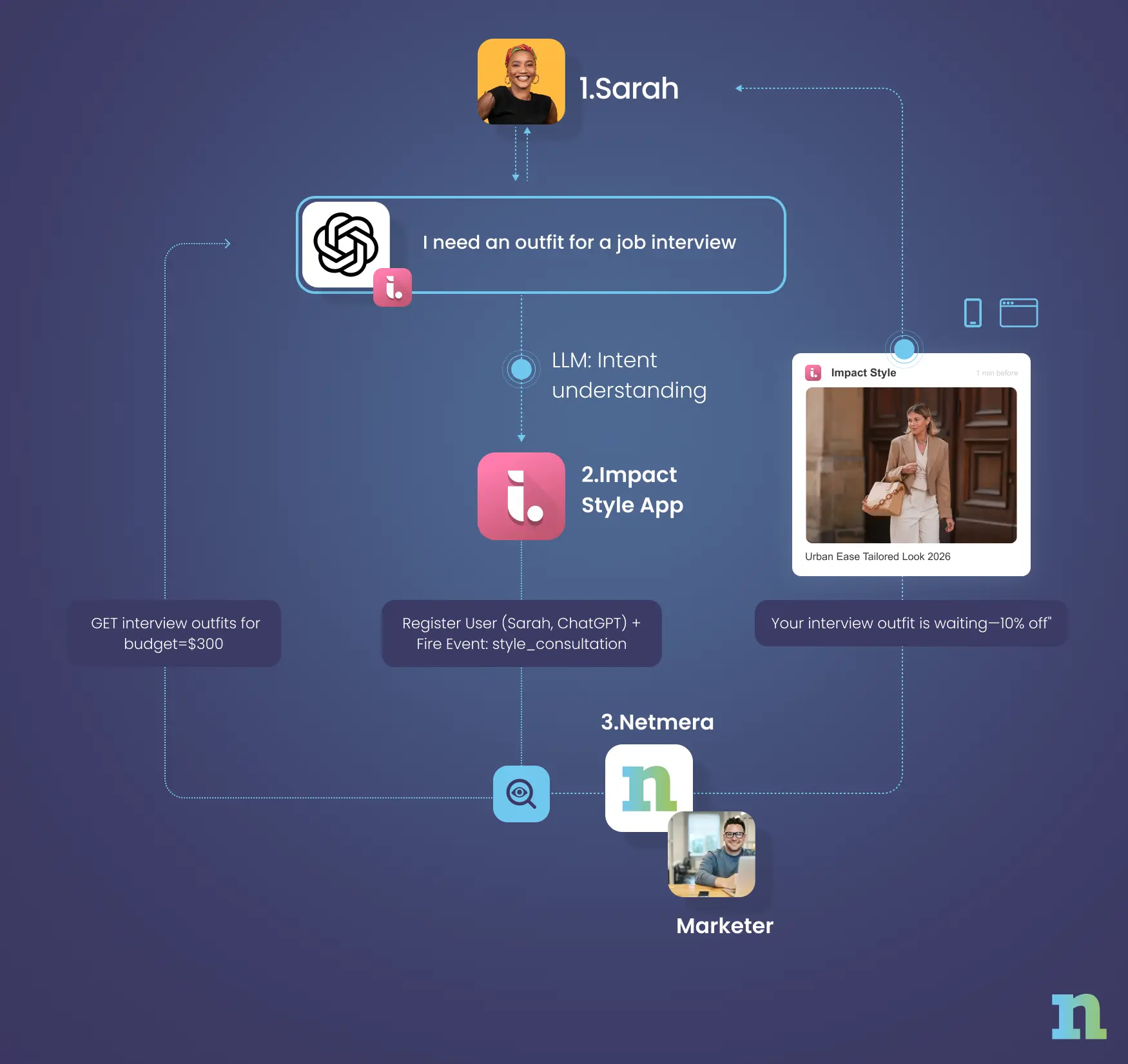
That’s why Netmera lets brands integrate their ChatGPT Apps into the platform. Conversational interactions flow into Netmera as structured events, feeding customer profiles, so brands can design and launch cross-channel campaigns that retarget those shoppers.
We can’t cover every personalization scenario here, but the core of it is simple: every personalized message depends on a customer profile that’s current, unified across channels, and built from real behavior.
Case study: beIN CONNECT, one of our media customers, ran into a pattern in their churn data: a sizable share of subscribers who signed up to follow one specific team lost interest and unsubscribed the moment that team had a bad run.
beIN CONNECT analyzed viewing history through Netmera’s data management and segmented those subscribers by what they watched. Then it surfaced other content on the platform, like movies, other leagues, and shows, that matched their broader viewing pattern. New subscriptions grew 3x and retention rose 10%.
Post-sale: retention decides who wins BFCM long term
“The metric for growth for a lot of especially established and mature retailers is not customer acquisition,” says Ian Dewar. Dewar is a retail app and loyalty strategist who has worked with The North Face and Anthropologie. For him growth comes from customer frequency. “If you can get your best customers to shop with you more often, they’re going to spend more money.”
Retention requires continuity: second-purchase nudges based on what someone bought during BFCM, usage tips for whatever they just picked up, and new-product notifications timed to when that specific customer is likely to be ready again.
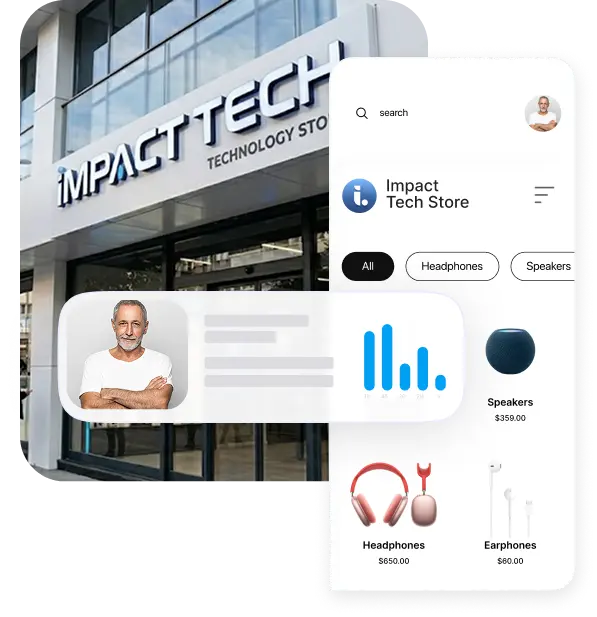
Email carries a lot of that continuity. This is where BFCM email personalization earns its place, specifically in post-purchase lifecycle messaging. High-reach broadcast messages still work for initial awareness, but behavior-triggered automation, like browse abandonment, cart recovery, and back-in-stock alerts, is what brings the outsized return. Automated emails made up just 2% of total email send volume but generated 37% of all email-driven revenue last year.
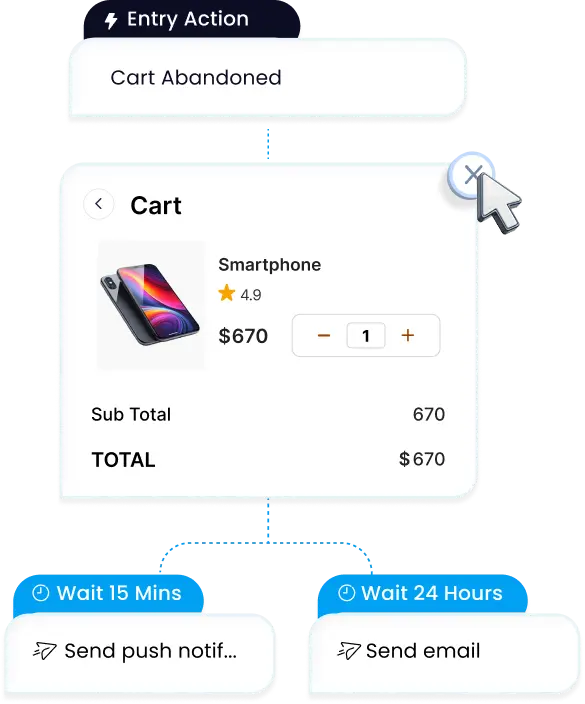
This isn’t specific to email marketing. Take a journey using push notifications. One of our customers in financial services used Netmera’s predictive AI to segment users likely to churn, then moved them into a 10-message sequence with Journey Builder. Anyone who opened the app at least once during the sequence stopped receiving win-back messages and continued through a different stage of the journey instead. The churn segment shrank 16.6%.
It could be WhatsApp, email, in-app, or geofencing. As long as channel selection follows the moment and where the customer engages, it improves the odds of bringing them back, whether for a second purchase or after a long silence.
BFCM isn’t only an ecommerce story
Almost all of the narrative around BFCM is written for ecommerce and retail, and rightly so, because they’re the obvious use case. If that’s you, our playbook covers the full customer lifecycle, from activation to retention. But industries like telecom, financial services, and travel are just as well positioned to reach their customers during this season and drive revenue.
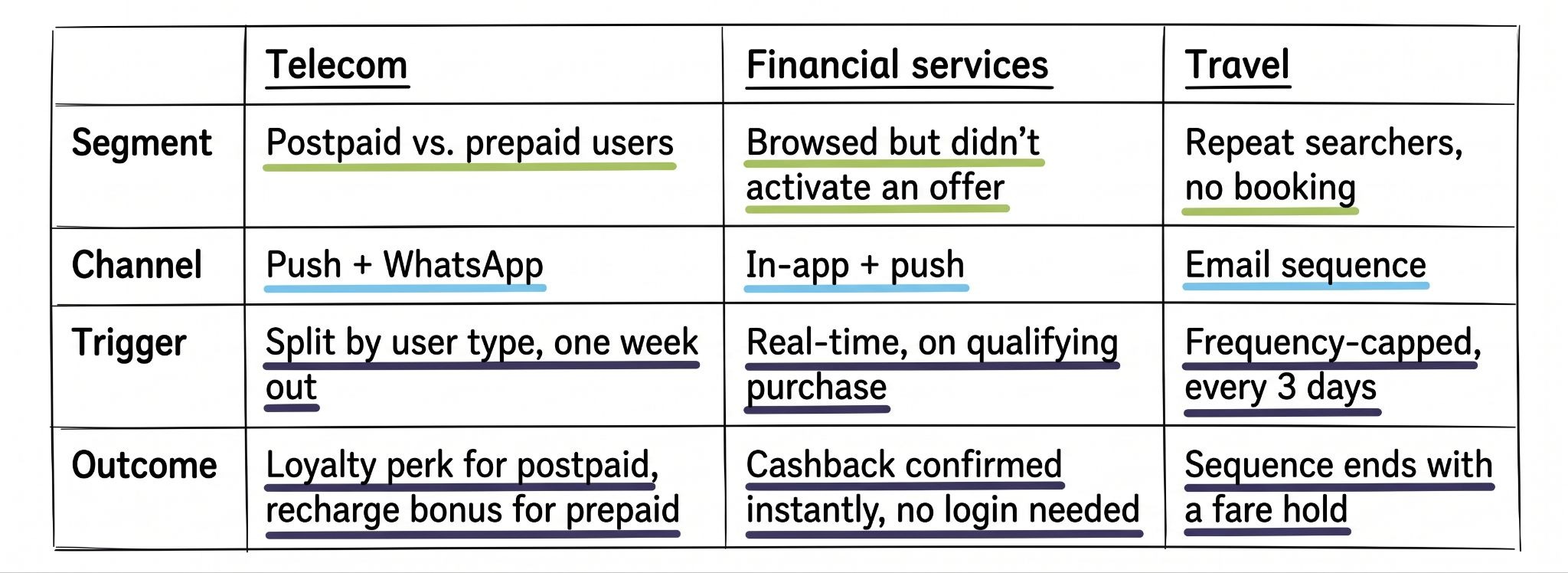
Below are three campaign examples, one each for telecom, financial services, and travel brands.
Telecom
Scenario: A telecom brand splits its base into postpaid and prepaid users a week before BFCM.
Capabilities and channels used: Behavioral segmentation separates the two groups. Postpaid subscribers get early access to a discounted device or data-bundle upgrade through push, positioned as a loyalty perk.
Prepaid users get a recharge-bonus WhatsApp message on Black Friday, timed to the evening hours when they typically top up.
Outcome: The brand reaches both segments with an offer that fits how each one buys and experiences the product.
Financial services
Scenario: A digital bank notices customers who browsed a cashback or installment offer but never activated it.
Capabilities and channels used: Three days before BFCM starts, an in-app preview with a countdown reaches those users. The moment one of them makes a qualifying purchase, a push notification confirms the cashback has been applied to their account.
Outcome: The customer sees confirmation the moment it happens, without needing to log in later to check. It’s the same browse-abandonment logic ecommerce uses for cart recovery, here applied to a financial product.
Travel
Scenario: A travel brand caps frequency during peak search season.
Capabilities and channels used: A user who keeps checking the same flight without booking gets a short sequence of three emails, one every five days, with a limited-time fare hold in the last one.
The sequence stops in two cases: the moment they book, or after the third email if they haven’t. In both cases they exit the journey, and the weekly cap keeps them from getting other promotional messages in the meantime.
Outcome: The brand stays present through a high-consideration purchase cycle without burning goodwill, so when the shopper is ready to book, the fare hold is still the message they remember.
Customers want to hear from brands early
BFCM spans presale, campaign period, and post-sale stages, starting as early as mid-October for many brands and customers. As David Parisi, SVP of Client Partnerships at Ibotta, puts it in eMarketer’s holiday shopping forecast, “the peak was never the whole picture. The bigger opportunity lies in the smaller moments leading up to it.”
Reaching customers that early only works if your data and messaging channels are in sync, which means the platform running them needs to unify data into a single customer profile, let you launch cross-channel campaigns through no-code builders, and track results in one place. That’s what Netmera does for its customers, for BFCM and year-round, across industries.
If this has given you ideas you can’t yet put into action with your current stack, reach out to our customer engagement experts. They’d be glad to hear what you’re working on and answer any questions.
FAQ on BFCM strategy and customer engagement
BFCM stands for Black Friday Cyber Monday, the shopping period running from the Friday after US Thanksgiving through the following Monday. In practice, marketers now use it as shorthand for the entire extended holiday shopping season, going beyond those four days.
Early-access windows built on loyalty and behavioral data, cart and browse abandonment sequences triggered by real behavior, frequency-capped journeys that coordinate across channels, and post-purchase continuity messaging that keeps a BFCM buyer engaged past the sale deadline. Each is covered in more depth in the sections above.
Yes. The underlying mechanisms, segmentation, orchestration, and real-time triggers activate on customer behavior. See the industry examples above for how telecom, finance, and travel brands can apply the same logic ecommerce uses for BFCM campaigns.
A BFCM strategy works across three stages. In the presale stage, brands use behavioral and predictive segmentation to lock in timing, copy, and offers by October, when over half of shoppers start browsing.
During the sale, cross-channel journeys run on frequency caps to control volume, while website and send-time personalization adjust each message to the individual customer.
In the post-sale stage, continuity messaging like second-purchase nudges and behavior-triggered automation turns a BFCM buyer into a repeat customer.
Burcu Ulucay – Content Marketing, Netmera