Omnichannel vs multichannel marketing: Key differences and when to use each
Last update: July, 2026
TL;DR: Multichannel and omnichannel aren’t competing strategies. They serve different goals at different stages. Multichannel is right for reach, new channel testing, and campaigns with segment-specific creative. Omnichannel is right for retention, lifecycle, and high-value segments, once your data is unified. Most teams stay multichannel longer than their strategy requires because their platform can’t bring data and execution together. This post shows where each fits, how to tell which one you need, and how to move from one to the other when you’re ready.
Marketers use up to 4 distinct channel categories to drive growth. More channels get added, budgets get split, and somewhere along the way the question of whether those channels work together gets lost.
97% of consumers say omnichannel experiences are critical, and CX leaders agree. Yet only 16% report having fully integrated technology and connected data to deliver them. That gap shows how much the omnichannel vs multichannel decision depends on goal, data maturity, and campaign type simultaneously.
Below: where the two strategies differ, which scenarios suit each, and how to sequence the move from one to the other when the time is right.
Omnichannel vs multichannel vs cross-channel: You’ll never mix them up again
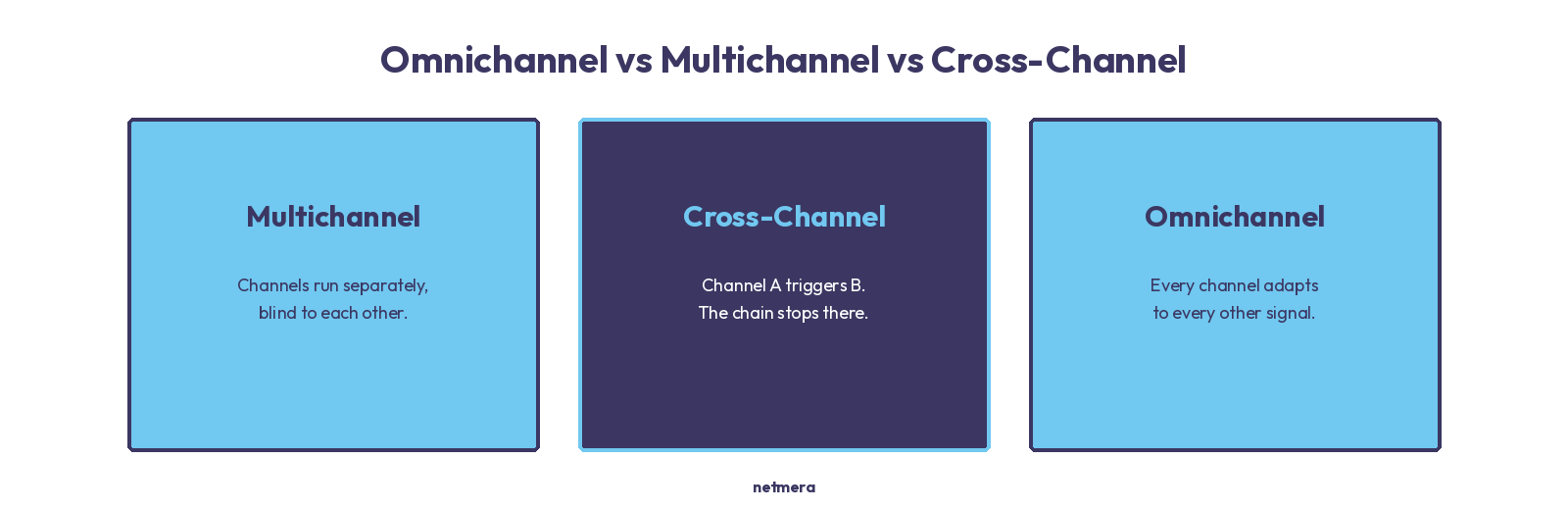
Multichannel: You run email, push, and SMS separately, each one blind to what the others did.
Cross-channel marketing: You connect channel A to channel B, but the chain stops there.
Omnichannel: What happens on one channel changes what you send on every other.
Multichannel means running campaigns across multiple channels, each operating independently. The goal is reach and presence. No shared data layer connects what happens on one channel to what happens on the next.
In cross-channel marketing, channels connect to a primary one, forming a directional funnel. A user clicks an SMS and lands on a pre-filled cart page. The channels are linked in sequence, but what the user does on that cart page doesn’t feed back into what they receive next. The data doesn’t flow back.
Omnichannel connects every channel through a single data layer that updates in real time. What a customer does on your website this morning changes what they see in your app later in the afternoon.
Platforms like Netmera consolidate data from mobile apps, websites, CRM, and offline sources into a single profile that updates as events happen. That profile is what every channel draws from.
| Capability | Multichannel | Cross-Channel | Omnichannel |
| Data integration | None | Partial | Full, real-time |
| Messaging | Channel-specific | Funnel-linked | Consistent + adaptive |
| Customer view | Fragmented | Partial | Unified |
| Personalization | Channel-level & campaign-based | Limited (only in the channels used) | Individual-level |
| Execution effort | Low-medium | Medium | High |
Omnichannel vs multichannel marketing: Four dimensions they differ
Data and customer view
More than 80% of consumers use multiple channels for product research or purchase. With multichannel, you see fragments of that journey: email opens in one dashboard, app sessions in another, push CTR somewhere else. With omnichannel, you see one continuous behavioral profile per customer, updating across every touchpoint.
Personalization depth
Multichannel marketing personalizes per channel. Omnichannel marketing personalizes per customer. 56% of consumers want brands to know their account history and current activities across interactions, a standard that multichannel setups structurally can’t meet. In Netmera, behavioral segmentation updates in real time as events come in, so cart additions, content views, and app opens feed directly into the next message across any channel.
Revenue visibility
Multichannel gives you channel-level metrics: opens, clicks, CTR, each sitting in its own report. You know which channel performed. You don’t know which interaction drove the purchase.
Omnichannel connects every touchpoint to a single customer journey, so you see which message, on which channel, at which moment, moved someone from browsing to buying.
Campaign focus
Multichannel asks: what goes out on each platform? Omnichannel asks: what should this specific person see next, based on where they are right now? One organizes campaigns around channels, with separate briefs, separate metrics, and separate teams. The other organizes them around the customer, with one behavioral profile driving every decision.
When multichannel marketing is the right fit
Brand awareness and reach
A fintech launching in a new market doesn’t need unified journey data on day one. It needs presence on the right channels with tailored creative per audience. Social ads, email to opted-in prospects, push to existing app users. Multichannel delivers that cleanly.
New channel testing
Running a channel independently before integrating it lets you measure its performance without noise from other touchpoints.
Resource and data maturity constraints
Before unifying channels, you need unified data, and building that foundation takes time, tooling, and team bandwidth that not every organization has at once. Data-driven marketing only works when the data itself is clean, consented, and centralized.
Campaign-specific logic
A product launch targeting distinct segments with channel-specific creative works better as multichannel. Video for social, detailed email for existing customers, push for app users: the goal is reach, and each channel delivers exactly that.
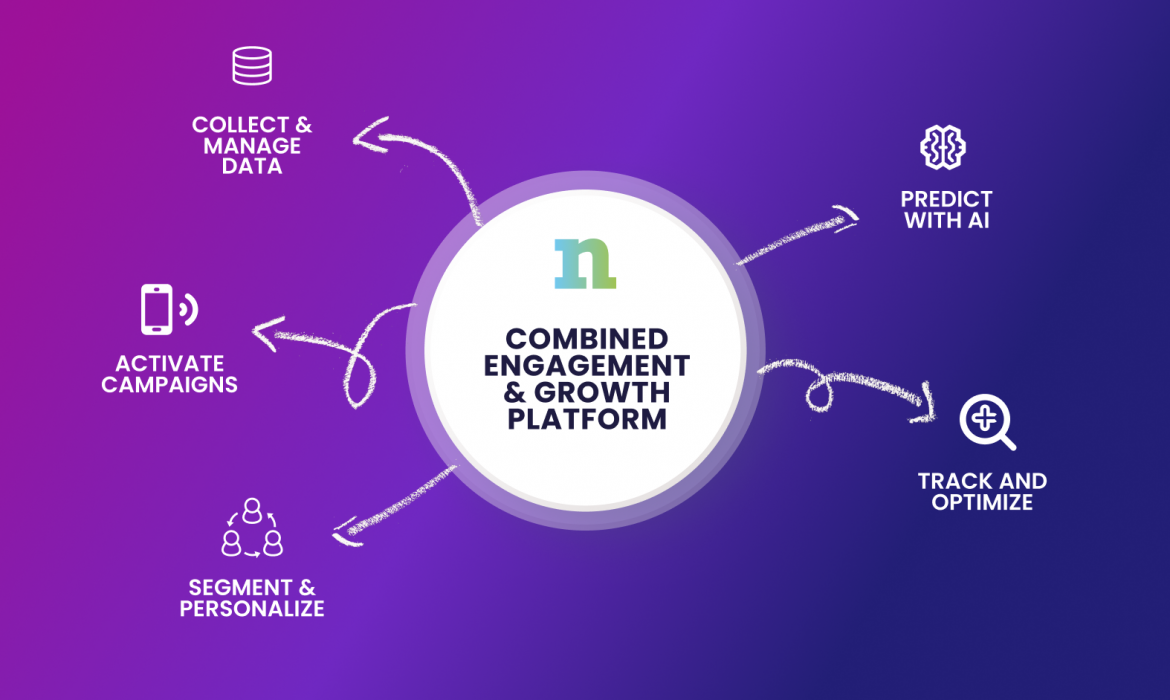
Netmera is built as an omnichannel platform, but teams don’t have to be omnichannel-ready to get value from it. Running multichannel campaigns across push, email, SMS, in-app, Live Activities, and web messages from one place is how many start. When they’re ready to connect their data and move toward unified customer journeys, everything they need is already there.
When to choose omnichannel over multichannel
Reducing churn and increasing lifetime value
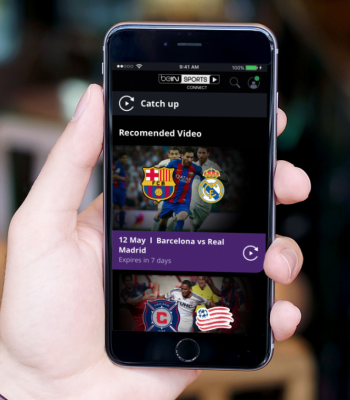
A subscriber who stops engaging after their favorite team loses three games is gone. Or is it? We saw they don’t have to be; they just need a different reason to stay. Using Netmera’s behavioral segmentation, beIN CONNECT identified these viewers and targeted them with alternative content across email, web, and mobile push.
All three channels ran from Netmera. New subscriptions grew 3x, active users increased 15%, and retention improved 10%.
Targeting high-value segments with personalized experiences
Omnichannel customers spend 30% more over their lifetime than single-channel customers. In banking, that shows up as faster funnel qualification and higher loan values. In premium retail, it shows up as repeat purchases and fewer discounts needed to close.
Maintaining context across every customer touchpoint
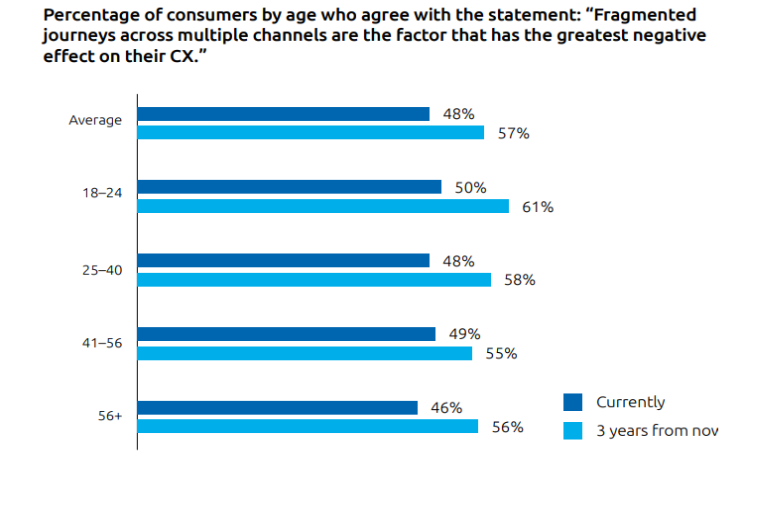
Three years from now, 57% of consumers say fragmented journeys across multiple channels will have the greatest negative effect on their CX. A customer who contacts support via chat and opens the app an hour later shouldn’t re-explain their issue or see the same offer they already declined. Delivering a seamless customer experience across those touchpoints requires every channel to share what it knows, in real time.
Turning AI predictions into immediate cross-channel responses
Without unified data, push and email go out the same day with different messages, neither knowing what the other sent. When the data layer is shared, AI stops being an insight waiting to be acted on. It becomes the response itself.
Companies with strong omnichannel engagement retain 89% of customers on average, vs. 33% for weak strategies, and more recent industry data shows omnichannel leaders consistently see higher CLV and retention.
Teams often read that stat and think the answer is more channels. It’s part of it. More than that, it depends on knowing where you are in your omnichannel maturity and moving at the pace your data and resources support.
The customer engagement platform you use should handle both, multichannel execution today and omnichannel journeys when you’re ready. Not sure your current platform can do this? These six questions will tell you.
How to move from multichannel to omnichannel in three steps
Step 1: Unify your customer data
Data-driven marketing starts when your CRM, your app, and your website stop living in separate places.
Netmera connects those sources into a single profile, pulling data in from your CRM, data warehouse, and third-party tools, and pushing enriched profiles back out. On the website side, Tagless Data Capture tracks behavioral data automatically without your team waiting on developers to instrument tracking code.
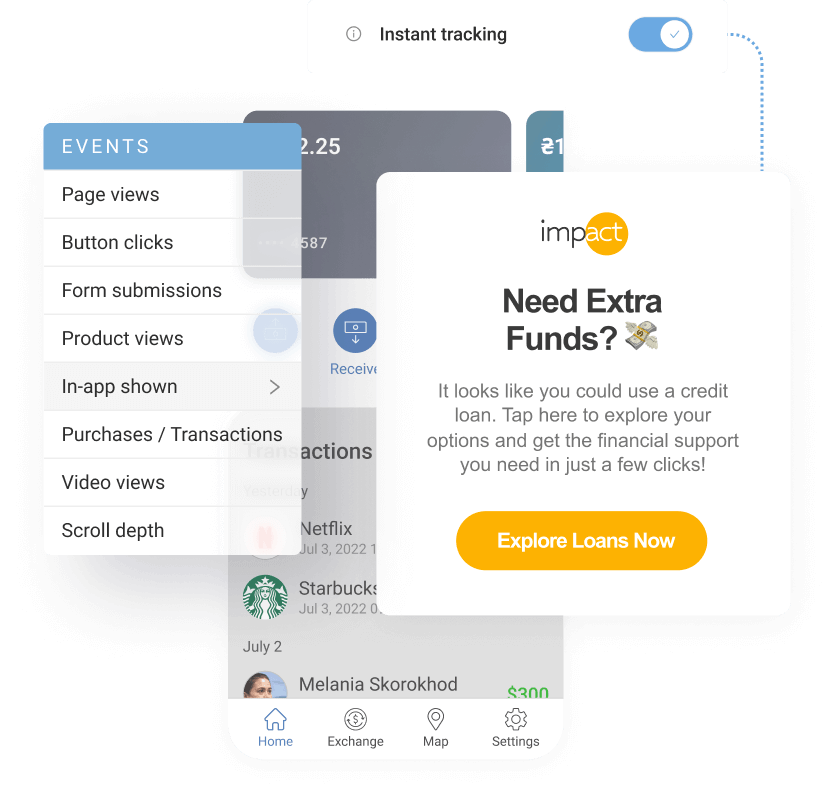
DenizBank saw what that unified view reveals. With a complete picture of their loan application funnel, they identified that Android users with outdated devices couldn’t view contracts due to a loading screen error. They fixed the issue, retargeted affected users with push notifications, and restored a 10% conversion rate while cutting bounce rates 41%.
Step 2: Map customer journey across channels
Once your data is unified, customer journey mapping becomes something you do with evidence. Netmera’s Funnels and User Paths show you real navigation routes: where customers enter, where they drop off, and what they do right before they leave.
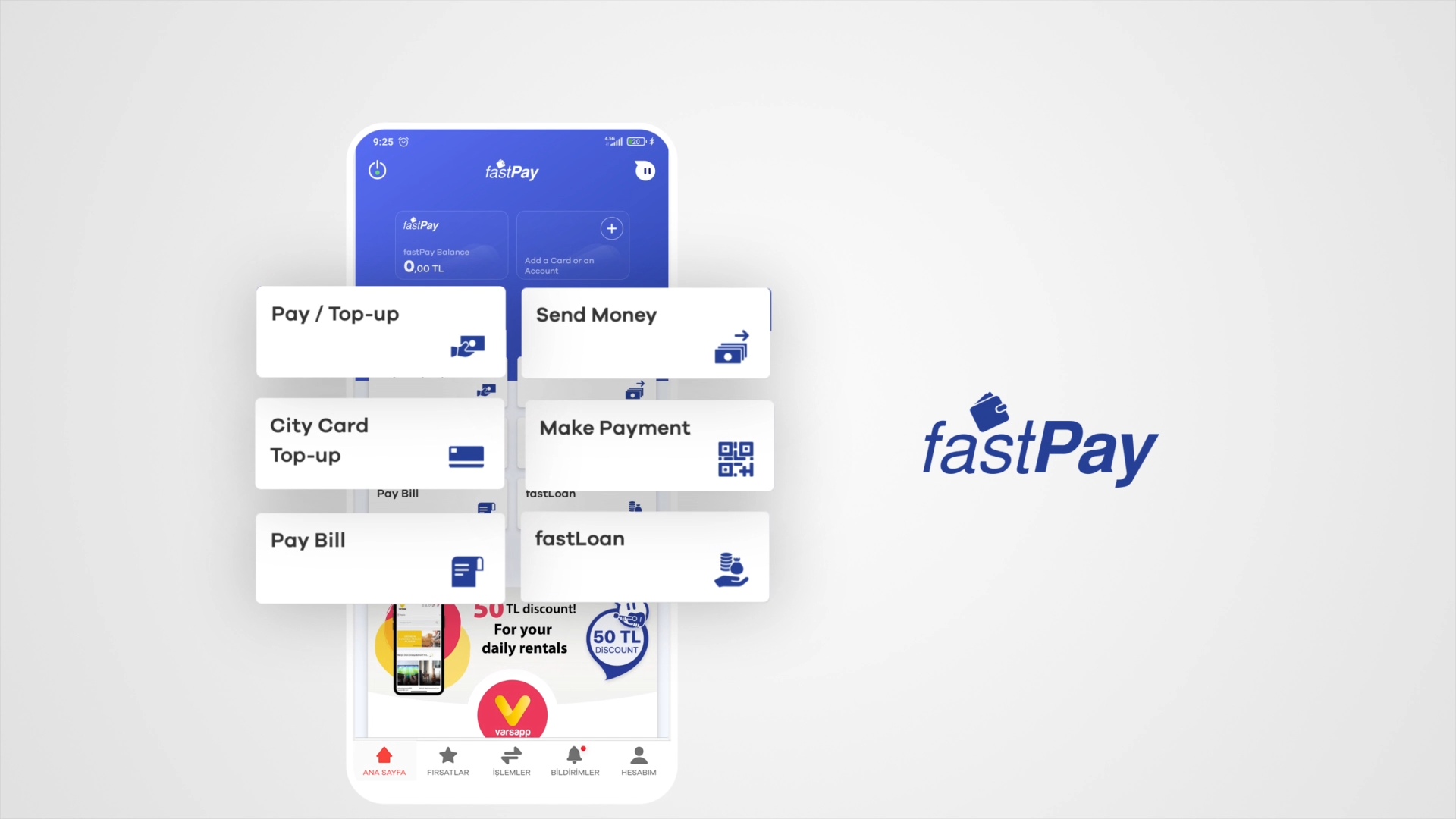
Take fastPay. They used exactly Netmera’s funnel analytics to identify where transaction friction was costing them conversions, then automated in-app messages at those specific moments. CTR increased 55% and conversions doubled.
Step 3: Build segments, then let journeys do the work
Segments built on unified behavioral data let you trigger the right next step per customer. This is where integrated marketing strategies start being effective.
UPTION had thousands of users across three languages showing early churn signals. Using Netmera’s predictive segments, they identified who was at risk and built a 10-message journey across customer touchpoints.
When someone returned, the sequence stopped. When they didn’t, the next message went out automatically. The churn segment shrank 16.6%, and 22.6% of participants converted. That kind of coordinated, language-aware journey is what a unified customer experience looks like at scale.
Omnichannel campaign strategy: Five things to get it right
Message suppression and frequency capping
Who wants to receive a push, an email, and an SMS within hours of each other? Not your users. Set suppression rules at the journey level in Netmera’s Journey Builder, so if a user has already received a message within a defined window across any channel, the next step holds until the window clears.
Timing per user with AI
Sending at a fixed time rarely works for all users in a specific segment. With our Best Time Delivery, send every push message at your users’ individually optimal hour per weekday. New users fall back to the app’s peak hours until enough personal data builds up.
A/B testing within journeys
Test message variations, channel order, and timing before scaling. Netmera’s journey variants allow dynamic personalization across every step, so A/B tests reflect meaningful differences in content and approach.
Consent and list hygiene
Stale push opt-ins and unclean email lists don’t just hurt deliverability; they corrupt the behavioral signals your entire journey depends on.
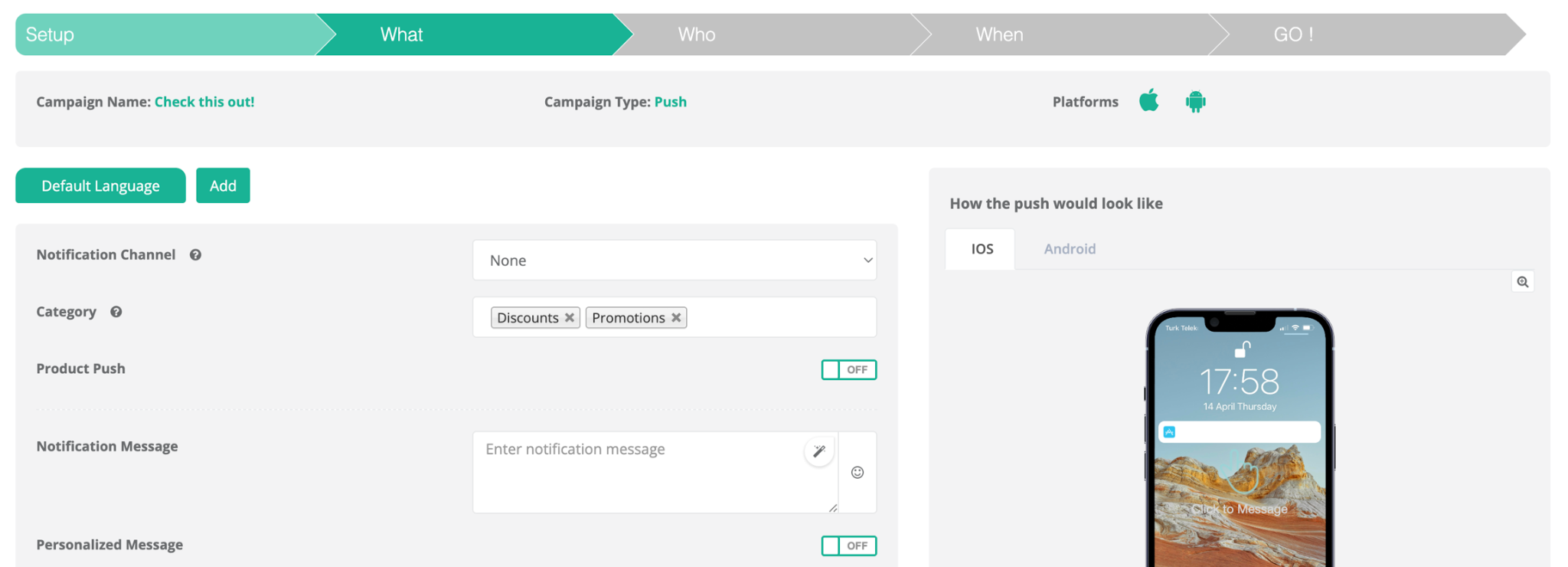
Netmera’s IYS Permission Hub and Message Categories let users control consent at the purpose level. They can opt out of promotions while staying reachable for order updates or system alerts. At send time, Netmera checks each recipient’s current consent status and excludes anyone who has opted out of that message category.
Journey analytics
Track entry counts, drop-offs, and conversions per step. Export non-converters and retarget them through a different channel. If a step consistently underperforms, adjust while the journey is live.
Multichannel vs omnichannel example: Retail campaign & fintech journey
Multichannel done right: Fashion retailer Mova enters a new market
Mova is launching in a new city. App users, an opted-in email list, and an SMS subscriber list are all they have. No considerable behavioral data on this audience yet.
They run a multichannel marketing campaign across three channels. Social ads target local users with store opening visuals. Email goes to prospects with an exclusive first-week discount.
Push notifications reach existing app users with a location-based welcome offer. SMS goes to opted-in locals with a store opening announcement and a one-time code. No cross-channel marketing logic connects them because the goal is reach.
A platform like Netmera would let Mova run all three channels from one place, with campaign analytics visible in one dashboard from day one.
Omnichannel done right: Digital bank Finn activates new depositors
A segment of Finn’s users completed their first deposit but haven’t returned in seven days. Finn knows their transaction history, their preferred features, and when they last logged in.
An automated journey starts. A push notification acknowledges the first deposit and surfaces the next feature worth trying.
The user opens the app but doesn’t act. An in-app message highlights a specific benefit tied to their account type.
Forty-eight hours pass. An email arrives with a concrete offer tied to their deposit amount. Every step reflects what the previous one revealed. The customer feels like Finn knows them.
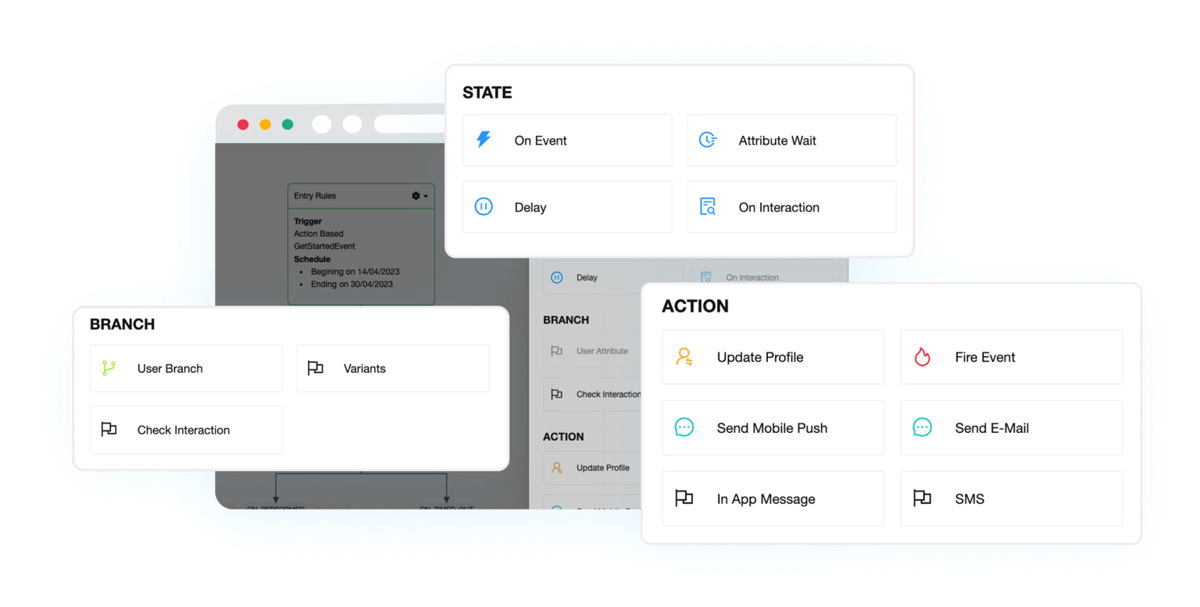
With Netmera, Finn’s marketing team would build and launch this entire journey through Journey Builder, using predictive segments and event-based triggers.
Our handbook shows how to build 10+ Customer Journeys From First Touch To Loyal Advocate.
Omnichannel vs multichannel decision: Which strategy is yours?
The tree below won’t cover every scenario, but it will point you in the right direction for most.
What is your primary campaign goal?
Reach + awareness
→
MULTICHANNEL
New channel testing
→
MULTICHANNEL
Campaign-specific creative per audience segment
→
MULTICHANNEL
Retention, lifecycle, or high-value segment
→
OMNICHANNEL
Do you have unified customer data?
No →
Step 1: data unification
Yes →
Do you know where customers drop off in your key flows?
No →
Step 2: map drop-offs and navigation routes
Yes →
Do you have opt-in audiences per channel?
No →
Audit consent layer first
Yes →
Step 3:
build segments and automate journeys in Netmera’s Journey Builder.
Multichannel is the right fit for some teams and the right call for some campaigns, even for teams running omnichannel journeys elsewhere. Yet most teams stay multichannel longer than their strategy requires, not by choice, but because the customer engagement platform they use doesn’t bring data, omnichannel messaging capabilities and analytics together.
See how Netmera does. Get in touch with us.
Omnichannel vs multichannel: Your questions answered
Multichannel runs each channel independently with no shared data. Omnichannel connects every channel through one real-time data layer: what a customer does on one channel changes what they see on every other. The result is a seamless customer experience that feels continuous rather than fragmented.
No. Omnichannel delivers stronger results for retention, lifecycle campaigns, and high-value segments. For brand awareness, new market launches, or new channel testing, multichannel is the sharper choice. The goal determines the strategy.
First, unified customer data: your app, website, and CRM feeding one profile in real time. Second, mapped customer journeys: knowing where users drop off. Third, behavioral automation: segments that trigger the right message per customer, per channel. Each step makes the next one possible.
Yes, with the right platform. No-code journey builders, automatic behavioral tracking, and AI-powered segmentation remove the developer dependency that makes omnichannel feel out of reach for lean teams.
A retailer entering a new city sends emails to opted-in prospects, SMS to the recipient list, and pushes notifications to existing app users. Each channel carries tailored creative. The goal is reach, and multichannel delivers that.
A digital bank identifies users who completed their first deposit but haven’t returned in seven days. An automated journey triggers a push, followed by an in-app message if they open the app, followed by an email if neither generates a response. Each step adapts to what the previous one revealed.
Companies with strong omnichannel engagement retain 89% of customers on average, compared to 33% for weak strategies. When every channel knows what the others did, re-engagement reflects actual behavior, content customers watched, features they used, rather than a broadcast that went to everyone.
Burcu Ulucay – Content Marketing, Netmera