
How marketers use an AI customer engagement platform, from segmentation to action
Last update: Nov, 2026
TL;DR
◆ An AI customer engagement platform offers AI as an assistant for marketing teams, from segmentation to cross-channel delivery and measurement.
◆ It needs to work on the brand’s up-to-date, accurate data to give insights that the marketer can use to set up and apply their communication strategy.
◆ An AI-powered customer engagement strategy includes predictive analytics, conversational AI that advises and guides, and agentic AI that drafts and sends.
◆ In-platform AI assistants and AI tools like Claude or ChatGPT through an MCP server are both part of today’s marketer’s setup, so the platform should provide both.
◆ Agents working autonomously without guardrails and permission roles may lead to a campaign reaching the entire user base before anyone has seen a preview, a live journey being stopped by mistake, or actions with no audit trail behind them.
Just 8% of the 300 CMOs in BCG’s survey run campaigns where multiple AI agents act autonomously, even though 96% of them say AI is changing how marketing works from end to end.
That imbalance may come from several places: fear of agents taking risky actions, doubts about security, uncertainty about which tools to choose, and having to move between different platforms to build a chain from targeting to campaign delivery. To us, it is all of these, and their weight changes from company to company.
Netmera integrates AI capabilities into its customer engagement platform from segmentation to action. It predicts who to reach, advises on what to do next and acts once the marketer approves, all on the brand’s own customer data.
Below, you’ll see two examples of how our customers use AI for customer engagement, what N-Assistant can do, and how marketers, CRM and CX people get an entire AI engagement bundle in one platform.
Predictive, conversational and agentic AI on one customer profile
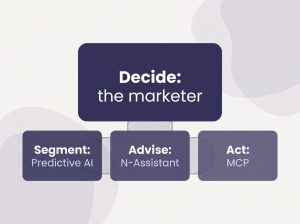
Predictive segments run on Netmera’s own machine learning and cover churn risk, purchase intent and engagement. N-Assistant is conversational: a read-only assistant tuned for marketing that explains what happened and recommends what to do next. The Netmera MCP server is agentic: AI tools such as Claude or ChatGPT build and send campaigns through it within guardrails, with the marketer’s approval.
ChiefMartec’s Martech for 2026 survey found that 56.3% of respondents named poor data quality as a significant difficulty in bringing agentic marketing to life. The first check for any AI customer engagement platform is the data it reads.
Netmera’s built-in customer data platform keeps one profile per customer from app, web and offline sources such as point-of-sale and CRM, and writes every message response back to it, which gives AI an accurate, always up-to-date data layer.
Example 1: run a retention campaign, from churn-risk segment to performance review
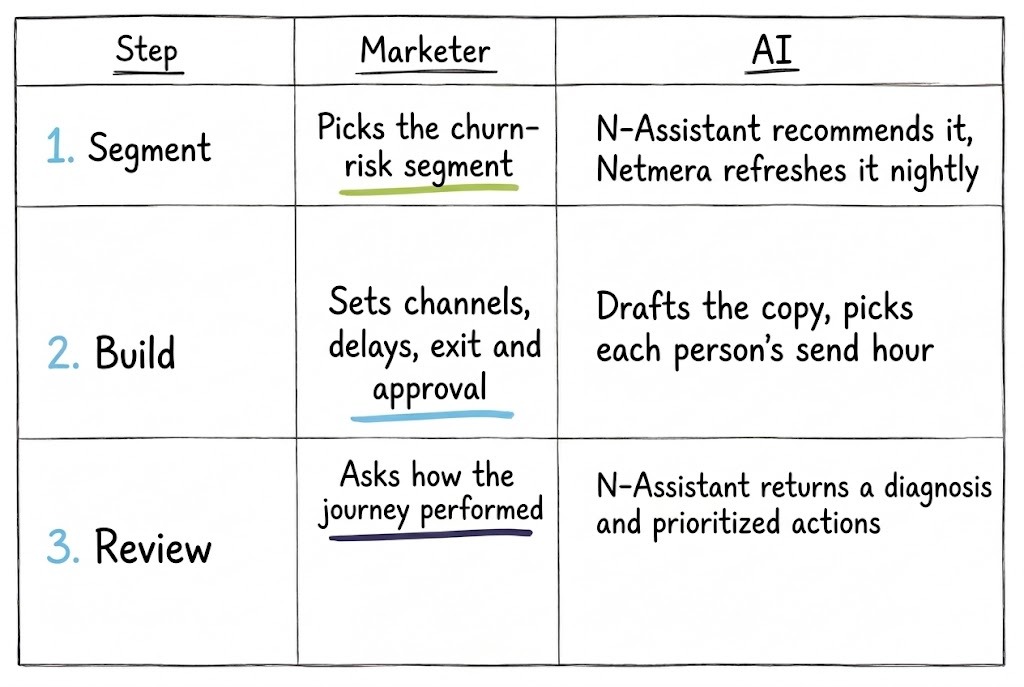
Here is how one retention campaign runs in Netmera, with the marketer deciding at every step.
Step 1: Find at-risk users with AI customer segmentation
A marketer using Netmera converses with N-Assistant, sees a segment at risk and decides to create predictive segments, following N-Assistant’s recommendations. A churn-risk predictive segment uses an event that defines activity (Open App, Transaction Made or Content Viewed), a past window for behavior, a prediction window for the outcome and a precision level. Higher precision gives a smaller, more accurate segment, and lower precision a larger one.
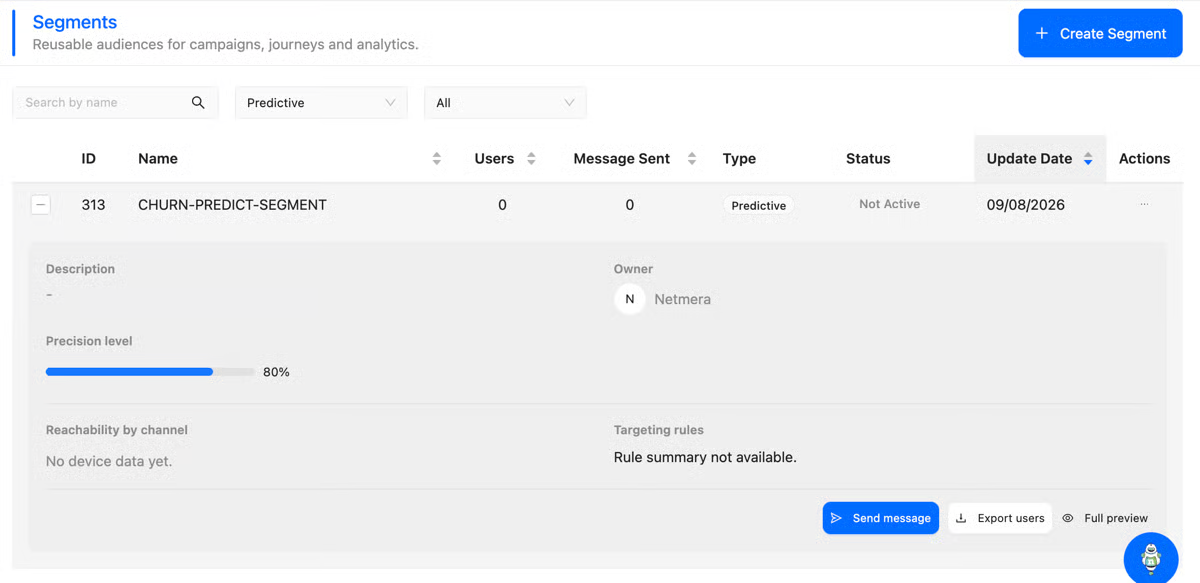
In Netmera, you work with your dedicated Customer Success Manager (CSM) to create a predictive segment. Once it is created and added to your panel, you select the segment as your audience, and this predictive segmentation refreshes every night.
UPTION built its AI customer retention campaign on this kind of segment. The team trained Netmera’s AI churn prediction on six months of behavioral data and started a 10-message recovery journey that targeted the users the model flagged as likely to churn within 30 days. The churn segment shrank 16.6%. Details and other metrics are in our success story.
Step 2: Build the journey, draft the copy and set each person’s send hour
Our marketer’s retention journey continues with deciding which N-Assistant recommendations to apply to the journey: which channels to use, how long the delays are, which frequency caps apply and which conversion event works as the exit, so returning users leave the sequence. Netmera customers build these journeys in the Journey builder.
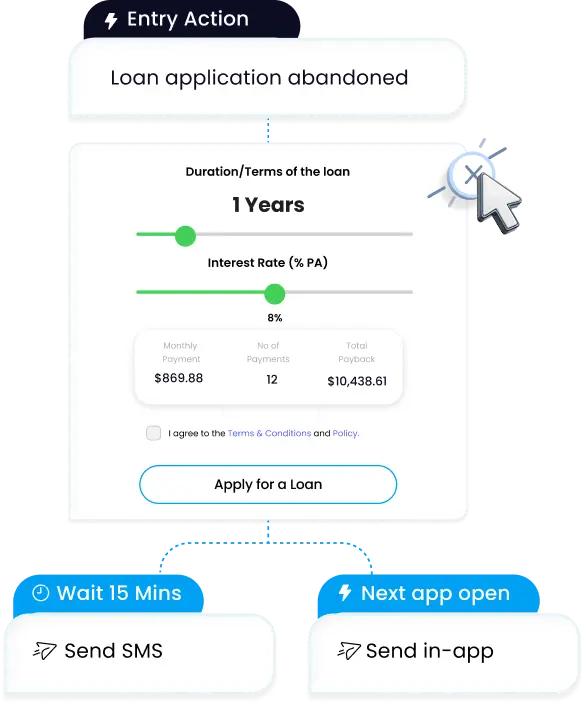
The marketer opens Content Optimizer, types a prompt such as “Encourage users to return to the app with a limited offer”, sets language, industry and the Increase Retention use case, and chooses from several suggestions. The prompt can also ask for a message that refers to what users bought or viewed before, with an offer matching their interests. The marketer then edits the AI-drafted copy, and can use Content Optimizer across channels, from push and SMS to email.
The marketer selects Best Time, and Netmera picks each person’s hour for that weekday from their last 60 days of Time in App activity. Anyone with an empty Time in App history gets the app-wide best time, and quiet hours stay respected. Send Instantly if Best Time Has Passed (optional) delivers immediately to people whose hour has gone by.
Channels, delays, exit and final approval stay with the marketer. AI suggests the draft copy and each person’s send hour.
Step 3: After delivery, ask N-Assistant how the campaign performed
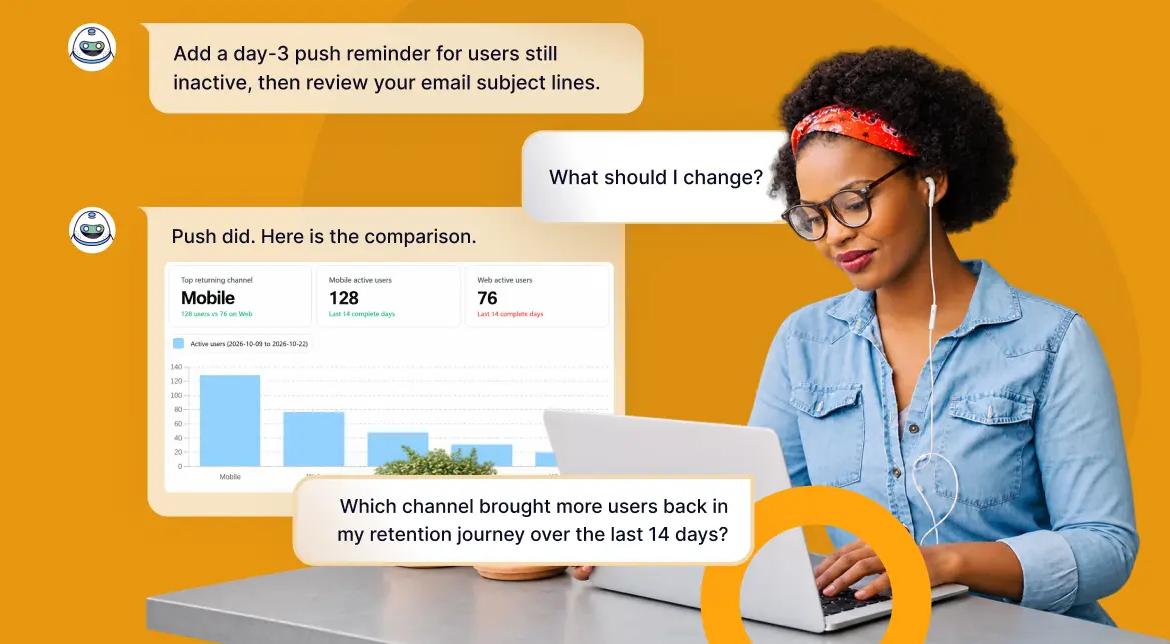
The marketer who started the campaign with N-Assistant returns to it for the review, across two channels: “Compare the push and email results of my retention journey over the last 14 days. Which channel brought more users back, and what should I change?” N-Assistant returns what it reviewed, how each channel performed, a diagnosis and actions in priority order. A useful analysis can become a custom dashboard in your panel.
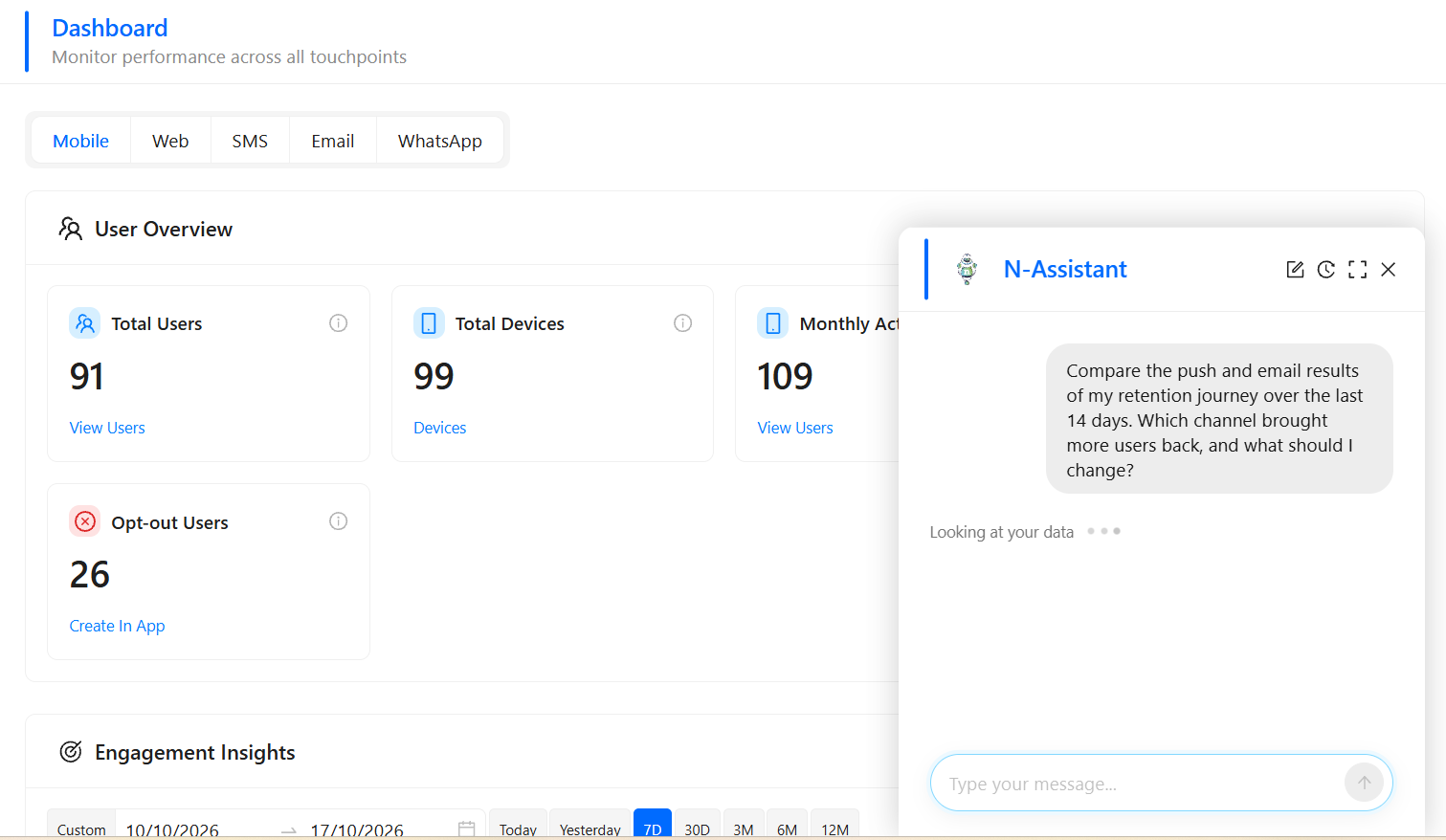
N-Assistant: an advisor in your panel that explains the numbers and ranks what to do next
ChiefMartec’s survey also found that 62.1% of respondents use AI agents embedded in their existing martech platforms. N-Assistant is Netmera’s embedded route: an AI marketing assistant in a chat panel that works with the data of your app in Netmera.
Coding, research and health already have specialized AI models, and “marketers deserve a consultant too,” as Netmera CEO Ahmet Başaran puts it. N-Assistant plays that role: it picks up the question behind a marketing decision, answers in plain language and ranks what to do next, and you decide what to apply.
Your AI marketing assistant, by goal: Analyze, find the reason, decide, draft
| Goal | What you ask | What comes back |
|---|---|---|
| Analyze | “Analyze my push campaigns from the last 30 days by send success rate and CTR, and tell me what to change.” | Send success rate, CTR, best and weakest campaigns, and recommended actions |
| Find the reason | “Opt-outs increased this month. Is there a relationship with my campaigns?” | A check of how opt-outs relate to campaign activity |
| Decide | “Based on the last 90 days, which channel should I prioritize for winback campaigns next month, and why?” | A recommendation in priority order, with the numbers behind it |
| Draft | A follow-up request for new copy | Draft text to copy into the campaign |
In a conversation with N-Assistant, ask it to draft. If you’re on a campaign page, it may be more convenient to use Content Optimizer. For better answers from Netmera’s AI marketing assistant, name the channel, campaign, goal and time range, and keep one conversation per topic.
How to read an answer before you act on it
In an N-Assistant answer, the scope statement comes first and says what was reviewed and for which dates, since an answer can cover a sample of the 20 most recent campaigns. The diagnosis and the recommended actions in priority order follow, then key figure cards, charts, tables and a follow-up suggestion.
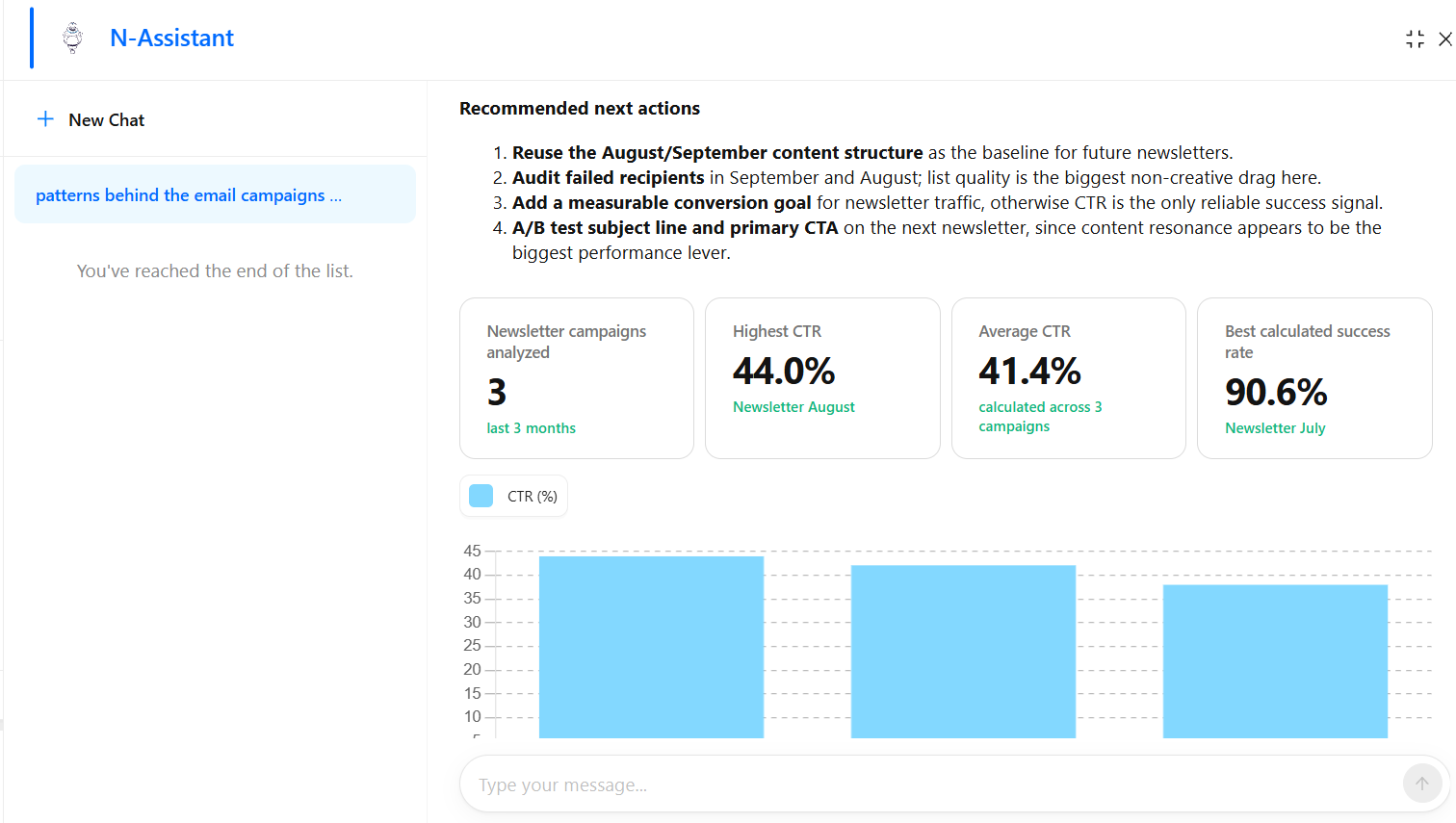
Take a winback journey that sends an in-app message to some users and a WhatsApp message to others. Netmera reports each channel’s rates against its own reach: impressions for in-app messages and the delivered count reported by Meta for WhatsApp.
When N-Assistant compares the two, check that both results use the same conversion window, since a rate measured over 24 hours and a rate measured over seven days cannot be compared. Whenever a decision depends on a figure, compare it with your panel reports.
What N-Assistant can see, and what stays in your hands
An AI customer engagement platform should answer two questions: what data the AI reads, and what it’s allowed to do. N-Assistant reads the data you already have in Netmera, including its data structure and campaign logic, so answers are shaped by your own setup from the first question.
What it is allowed to do follows your Netmera role. Netmera checks that role on every request, so two colleagues with different roles can get different answers.
Netmera built N-Assistant with “customer data protection by design,” as CTO Burak Kaymaz describes it. Customer personal data stays inside Netmera, and information that identifies your brand is withheld from tool results.
N-Assistant works in read-only mode, so campaigns, segments and workflows remain untouched and, in Başaran’s words, “the decision to act always stays with our users.”
| N-Assistant can | Stays in your hands |
| Analyze analytics, campaign reports and A/B tests | Sending campaigns |
| Review workflows, automations, events and profile attributes | Changing segments or workflows |
| Recommend next actions | Contacting end users |
For AI that acts, the Netmera MCP server connects Claude or ChatGPT to the same data.
Example 2: Agentic AI in marketing on your own Netmera data
Marketers who work with agentic AI in marketing often have Claude or ChatGPT open all day, and signing into another platform in the middle of a task would be extra work. With the Netmera MCP server, they ask questions, build segments and draft campaigns from the AI tool. We committed to keeping that flexibility, and it is one reason 100+ enterprise companies use Netmera.
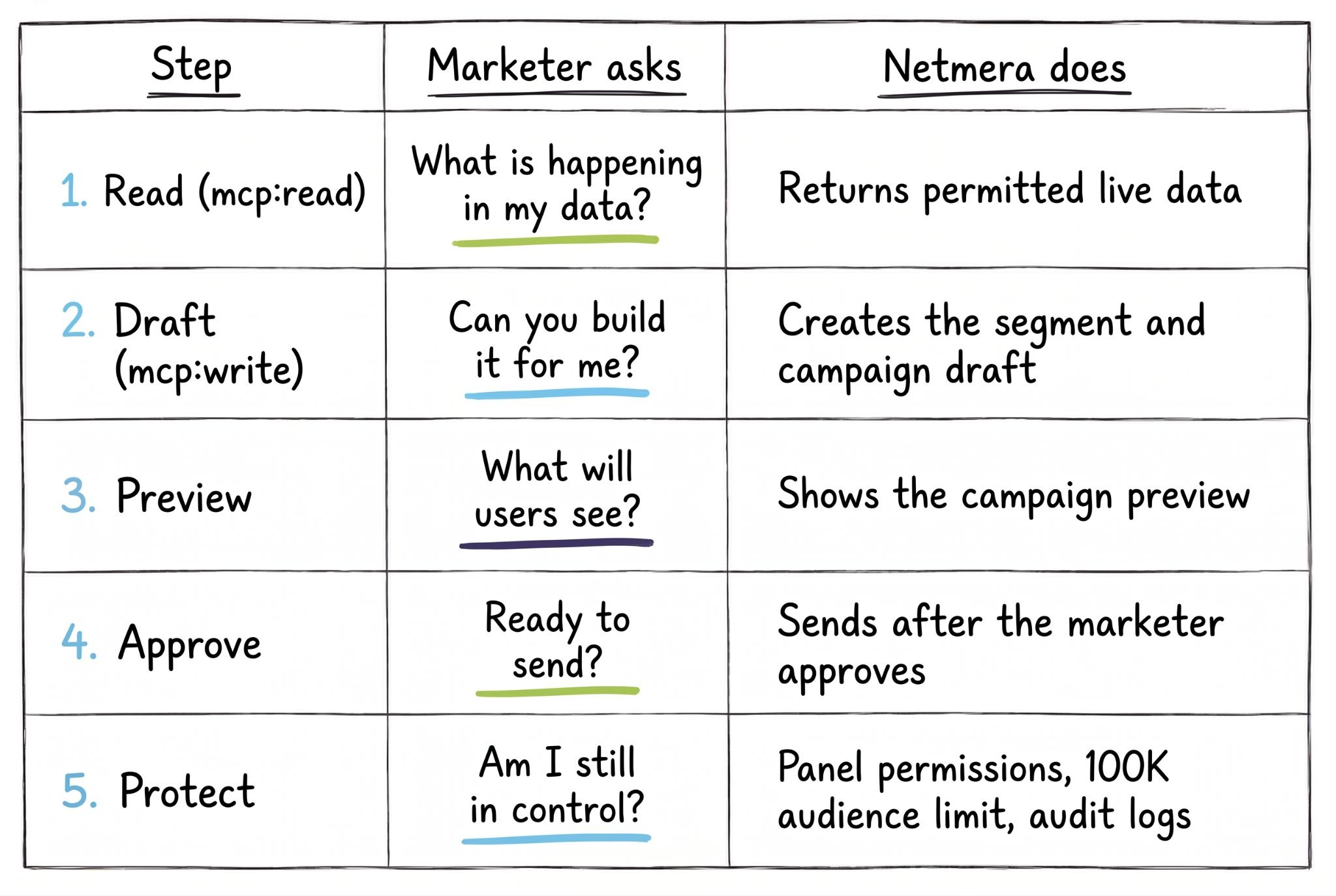
The first request goes to live data with a read-only token: “Which campaigns brought the most revenue in the last 30 days?” The marketer types it, the AI tool picks the relevant Netmera function, Netmera returns the permitted data for the connected app, and the tool writes the answer. The AI client receives only the results of the tools called in that conversation.
Read first: Ask Claude or ChatGPT about Netmera data
Other read functions cover questions like these:
– “Compare retention between Sign Up and First Purchase for users who joined in September 2026.”
– “Break down Add to Cart events by platform and country for the last 14 days.”
Draft, preview, approve: Where AI takes action and where it stops
When the team is ready to act, the marketer regenerates the token with mcp:write. A prompt such as “Create a segment of users who viewed our best-selling running shoes at least two times in the last 7 days, then draft a campaign for cross-sell with a free shipping offer and show me the preview” makes the AI tool create the segment, build the draft and show a preview.
Once the marketer approves the preview, Netmera sends the message across the channels the marketer selected.
Our AI customer engagement platform applies five guardrails to keep every AI action under the marketer’s control:
– Actions stay inside the user’s panel permissions.
– Creating or changing anything needs the mcp:write scope, a separate permission on the token. A token with mcp:read can only query data.
– Every campaign message needs a preview and approval before it goes out.
– Audiences above 100,000 users are blocked from direct AI sending, and Netmera returns a panel link to finish the campaign there.
– Every action is recorded in audit logs.
Read the details in the Netmera MCP server documentation. Our MCP post looks into use cases, prompts and a marketer’s daily workflows.
Shoppers find the right product with AI Site Search & Browse
Predictive segments, N-Assistant and the MCP server work on the marketer’s side of the screen. AI Site Search & Browse works on the shopper’s side, on the brand’s own online store.
Retailers are investing here. Arkticfox’s Inside Digital & eCommerce 2026 found that 76.1% target moderate or significant investment in onsite search and discoverability.
Our solution understands typos, synonyms and descriptive queries, so a misspelled word or a loose description still leads to relevant products. When an item is missing from the catalog, it suggests close alternatives. On category pages, it re-ranks listings for each visitor’s behavior in real time.
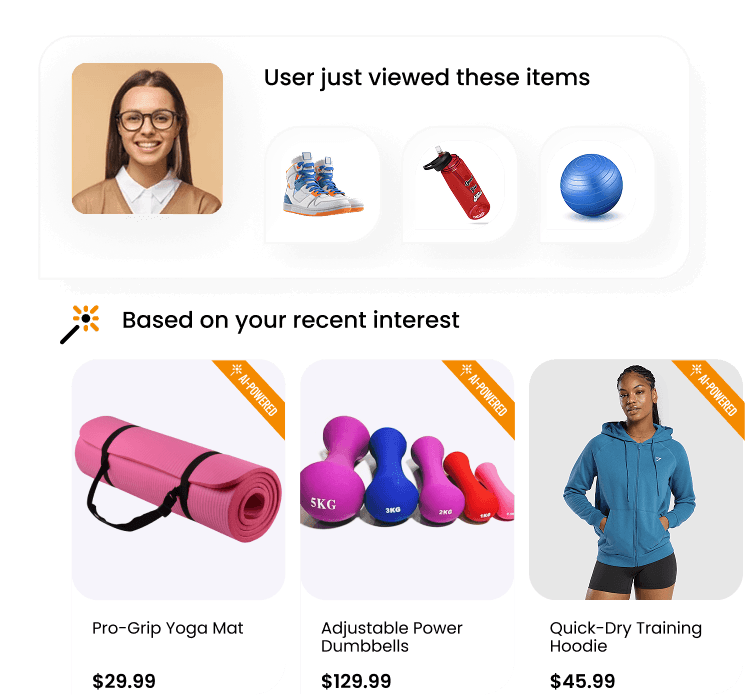
From a no-code dashboard, marketers and merchandisers promote, hide or reorganize products and rank by revenue, conversions or profitability. Reports on top searches, no-result queries and conversion rates show what shoppers want, including products the catalog lacks.
To see where your own site stands, type a misspelled product name and a loose description into the search box and look at the results. If they fall short of what you and your shoppers expect, AI Site Search & Browse is built for exactly these queries.
Start with N-Assistant on your own data
N-Assistant is open to every Netmera customer, and prospects can see it on a demo app, so it is a low-risk first test to see how in-platform AI for customer engagement works.
Get in touch with us to see predictive segments, N-Assistant and MCP on your own data in one session.
FAQ on AI customer engagement platforms
It is a platform that uses AI to find who to reach, explain what happened and act on customer data across channels, with the marketer deciding at each step. The platform keeps prediction, analysis and action on one customer profile.
AI in customer engagement works in three places: choosing the audience, reading performance and producing messages. Predictive models flag users earlier than manual rules, an AI assistant shortens the path from a question about the numbers to a recommended action, and AI-assisted copy and send times speed up message creation and timing.
Compare the outcomes the AI was used for. Check conversion and retention in AI-assisted campaigns against a control group or a fixed baseline, and for send-time optimization compare open and click rates with messages sent at a fixed time. Dashboards that keep these figures in one place make the comparison repeatable.
Results depend on the use case and the data behind it, and retention is a common place to start. UPTION’s churn segment shrank 16.6% after a 10-message recovery journey built on AI churn prediction, and 22.6% of the users who entered the journey converted. Read the UPTION case study.
It checks permissions on every request, keeps the AI read-only unless write access is granted, requires a preview and approval before anything sends, blocks sends to very large audiences from direct AI execution, and records every action in audit logs. It also keeps customers’ personal data away from the AI model, returning only the results of the tools called, with personal fields masked where relevant.
Burcu Ulucay – Content Marketing, Netmera


