Ecommerce Customer Engagement Statistics: Benchmarks and Trends for 2026
Last update: April 2026
TL;DR: Ecommerce teams have more data and AI tools than ever, but fragmented infrastructure is preventing most from using either effectively. Personalization is a near-universal priority, yet only a fraction of teams can deliver it across channels. Mobile is becoming the primary purchase surface, but app retention collapses after day 30. Omnichannel works when channels share data and respond to behavior.
Ecommerce teams in 2026 have more behavioral data, more channels, and more AI tools than they have ever had. Consumers are less trusting than they have been in years. Both things are true at once.
PwC’s 2025 Customer Experience Survey found that 90% of executives believe customer loyalty is growing, yet only 40% of consumers agree. Forrester’s Chief Research Officer said it directly: consumer tolerance for surface-level personalization is already fading, and brands that don’t close the gap between promise and experience will lose customers who have plenty of alternatives.
This post covers ecommerce customer engagement statistics across four themes: personalization and AI, data and fragmentation, omnichannel engagement, and mobile. The scope includes ecommerce sites, retailers with physical stores and apps, and marketplace sellers. Each section pairs the benchmark with what it asks of your team.
Ecommerce Customer Engagement at a Glance
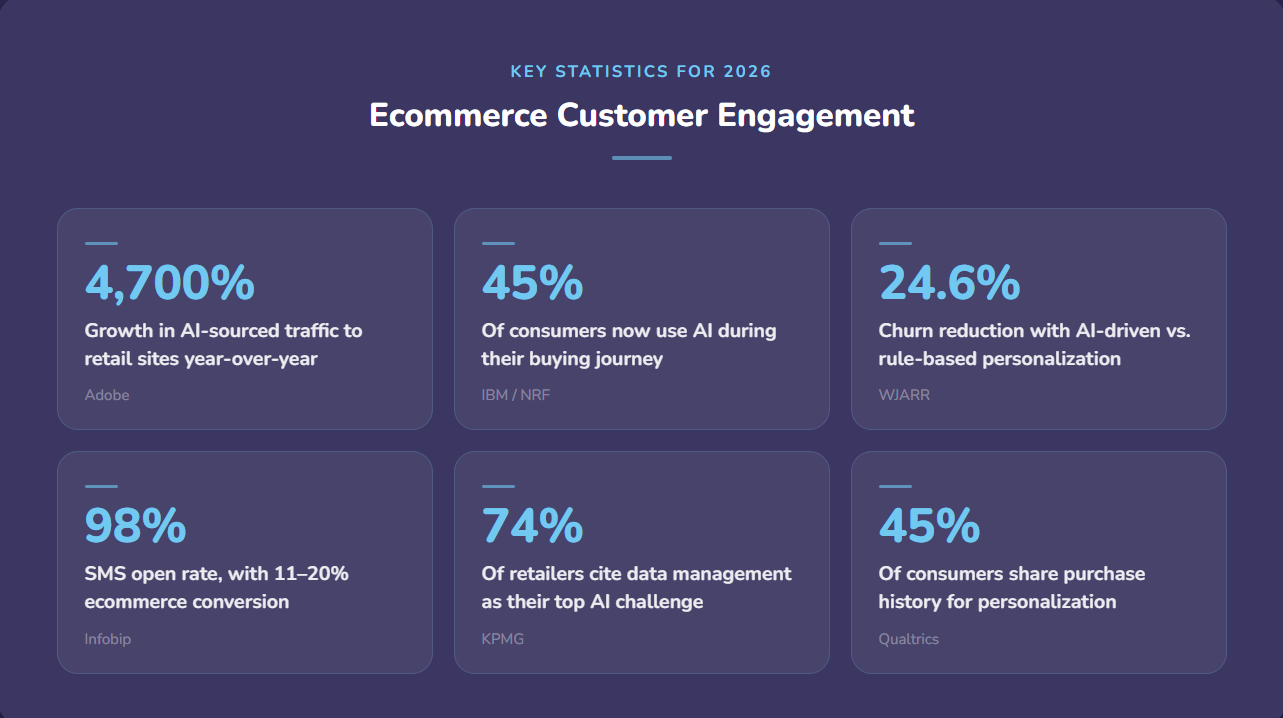
◈ AI-driven personalization reduces churn by 24.6% and increases average order value by 17.8% compared to rule-based methods (WJARR)
◈ 74% of retailers say data management is their primary challenge in scaling AI (KPMG)
◈ Traffic from generative AI sources to retail sites grew 4,700% year-over-year as of mid-2025 (Adobe)
◈ 45% of consumers now use AI during their buying journey (IBM/NRF)
◈ SMS open rates hit 98%, with ecommerce conversion rates of 11–20% (Infobip)
◈ Consumers are most comfortable sharing purchase history (45%) and website visit data (42%) for personalization; trusted companies gain an 8-point comfort advantage per data type (Qualtrics)
AI Personalization in Ecommerce: The Gap Between Priority and Execution
BCG projects $2 trillion will shift to companies that get personalization right over the next five years. Within retail, personalization leaders grow revenue 10 percentage points faster than everyone else.
The harder number: 63% of companies call ecommerce personalization a top priority or claim it’s already part of their DNA. Only 24% effectively invest in omnichannel personalization. Most teams know what good ecommerce personalization software should do. Putting it into practice across channels is what slows down teams.
How Behavior-Based Personalization Drives Registration and Revenue
A globally recognized coffee chain had strong app installs, but users dropping off before completing registration. The team used Netmera’s Funnel Analytics to find where, then built an automated journey in Journey Builder that sent reminders at each point where users paused. Registration events increased 90%. The journey drove 35% of total registrations and ran without any manual effort.
The ecommerce customer journey statistics on AI personalization point the same direction. A WJARR study found that companies using generative AI in ecommerce for personalization reduced churn by 24.6% on average and increased average order value by 17.8% compared to rule-based methods.
Why Consumer Trust in AI Personalization Is Falling (And What Fixes It)
There is one complication worth naming. Salesforce found that only 42% of customers trust businesses to use AI ethically, down from 58% in 2023. 89% of marketing decision-makers still consider personalization essential. Personalization built on what users do is what earns trust back.
Closing that trust distance requires behavioral data and AI working together. Netmera connects both, so every campaign starts from what users did, reviewed and approved by your team before it goes live.
Data and Fragmentation: The Real Reason Personalization Stalls
KPMG’s Intelligent Retail Report shows how far most retail operations are from real-time omnichannel ecommerce:
◈ 74% of retailers say data management is their primary challenge in scaling AI
◈ Only 28% have achieved system-level data integration
◈ Only 13% have a data warehouse with real-time updates
◈ Just 7% have fully automated their data integration
The data exists. It is just scattered across CRM, apps, websites, and warehouses with nothing connecting them.
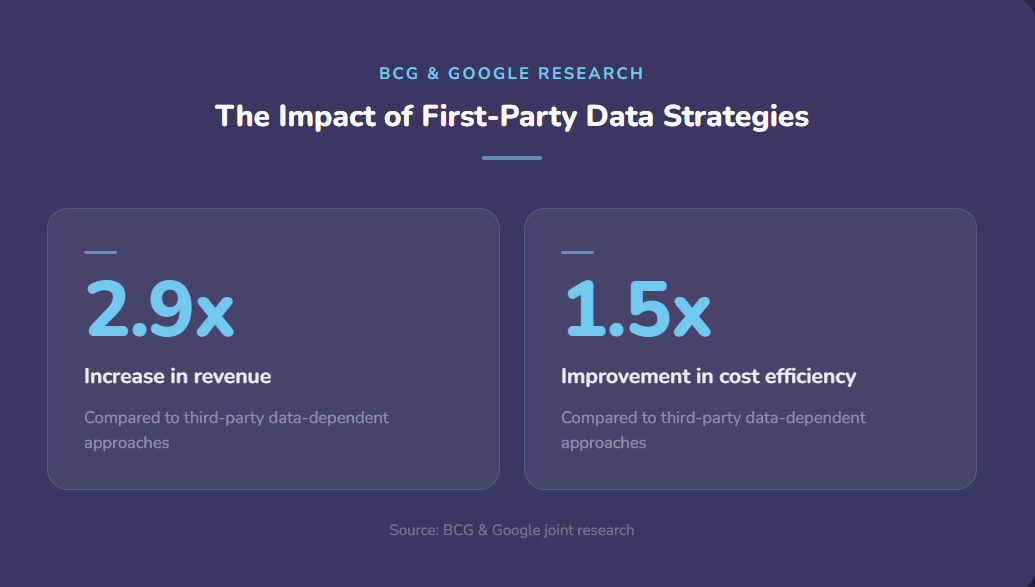
BCG and Google’s joint research found that first-party data strategies deliver a 2.9x increase in revenue and 1.5x improvement in cost efficiency compared to approaches dependent on third-party data.
As third-party cookies continue to lose ground, that advantage will only grow. The brands building direct, consent-based relationships with their customers now are the ones with clean data to act on later.
In Netmera, unified customer profiles consolidate data from apps, websites, CRM, and offline sources into one continuously updated customer profile. Tagless Data Capture collects behavioral data automatically from websites and apps. Teams start tracking first-party behavioral data from day one, without waiting on IT.
David Chan, Managing Director at Deloitte Digital, put the bar clearly: “The data has to be real-time collected, real-time processed, and real-time curated to then be activated on in real-time.”
From Fragmented to Connected: 150% Revenue Growth
Turkcell Pasaj, Turkcell’s ecommerce platform, was losing potential revenue to cart abandonment. Working with Netmera, the team built behavior-triggered push notifications that fired automatically when users left items behind.
Monthly revenue increased 150%. Conversion rate doubled from 4% to 8%.
Customer engagement platforms that combine customer data, AI-driven segmentation, and campaign tools in one place are becoming the standard in ecommerce and retail. The Business Leaders CX Report by Five9 and CX Network found that 42% of retail businesses are already implementing integrated channels on a single platform, the highest rate among all industries.
Unified platforms with built-in AI that predicts behavior and supports campaign setup, like Netmera, are where the category is heading.
Passo is one of the platforms running it this way. Passo Dükkan, the marketplace inside Passo’s ticketing app, had a discovery problem: users opened the app for events and rarely found the shop.
The team built a three-stage behavioral funnel in Netmera: a post-signup push for new users, a browse-abandonment message for category explorers, and a cart recovery reminder for high-intent drop-offs, each timed to where users stopped.
CTR reached 4.15% at the cart recovery stage, a 192% improvement over the awareness stage. Revenue increased 9X over baseline.
Omnichannel Engagement: Channel Fit Beats Channel Count
The business case for omnichannel ecommerce has been settled for years. Companies with strong cross-channel engagement retain 89% of their customers. Those with weak strategies retain 33%, according to Aberdeen Group. HBR’s study of 46,000 shoppers found that omnichannel customers spend 4% more in-store and 10% more online than single-channel customers.
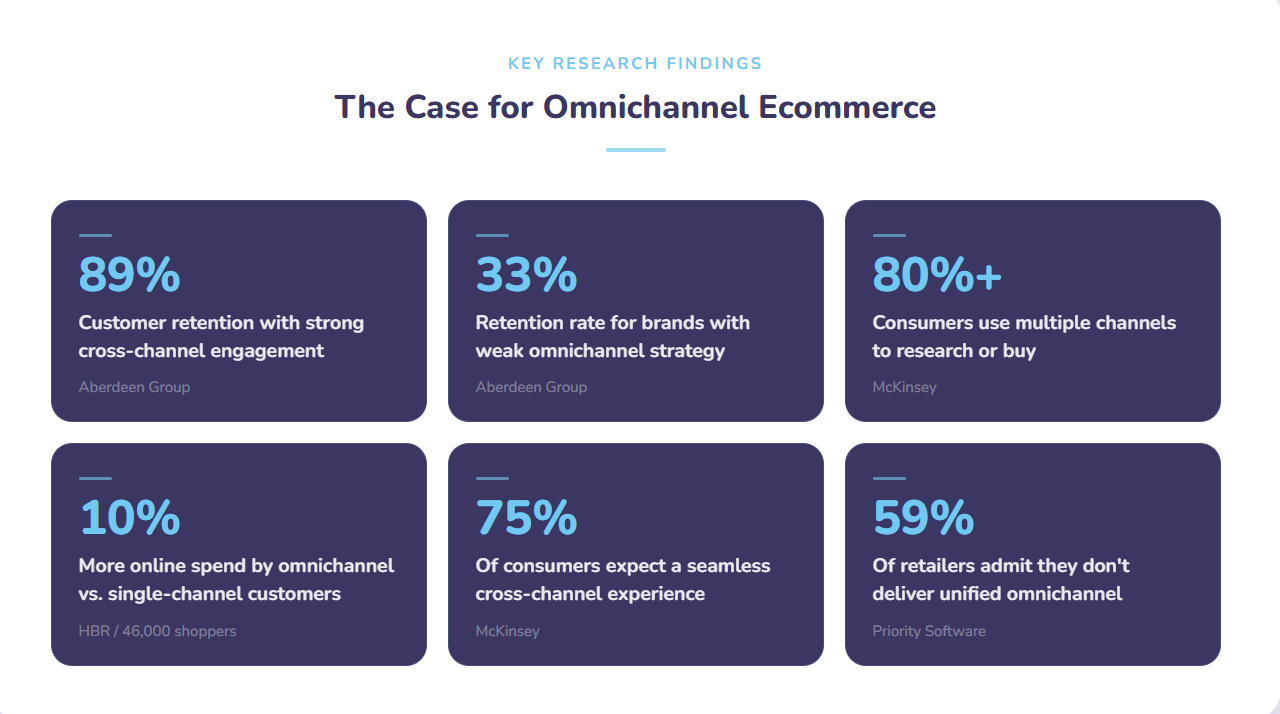
McKinsey reports that more than 80% of consumers use multiple channels for product research or purchase. Are brands meeting them well or just meeting them?
75% of consumers expect a seamless experience across channels while only 25% feel retailers deliver it, per another McKinsey research. 59% of retailers admit they are not delivering a fully unified experience, a significant gap given how central omnichannel retailing has become to customer expectations.
Most treat omnichannel as volume: more messages, more touchpoints, more reach.
Choosing the Right Channel for Each Moment in the Customer Journey
Sue Azari, Ecommerce Industry Consultant at AppsFlyer, makes the distinction clearly: “Omnichannel is now standard. Brands blending SMS, email, and push see more consistent engagement across the lifecycle. Phone numbers are high-trust data. If someone opts in, they want what you’re offering.”
When a user abandons a cart, the right response is a push notification. When they complete a purchase, a WhatsApp or SMS confirmation lands better than another push.
In Netmera’s no-code Journey Builder, teams set these rules themselves: which channel fits which moment, frequency caps to avoid overreach, A/B tests to find what works. AI helps with campaign insights, segment recommendations, and channel decisions along the way.
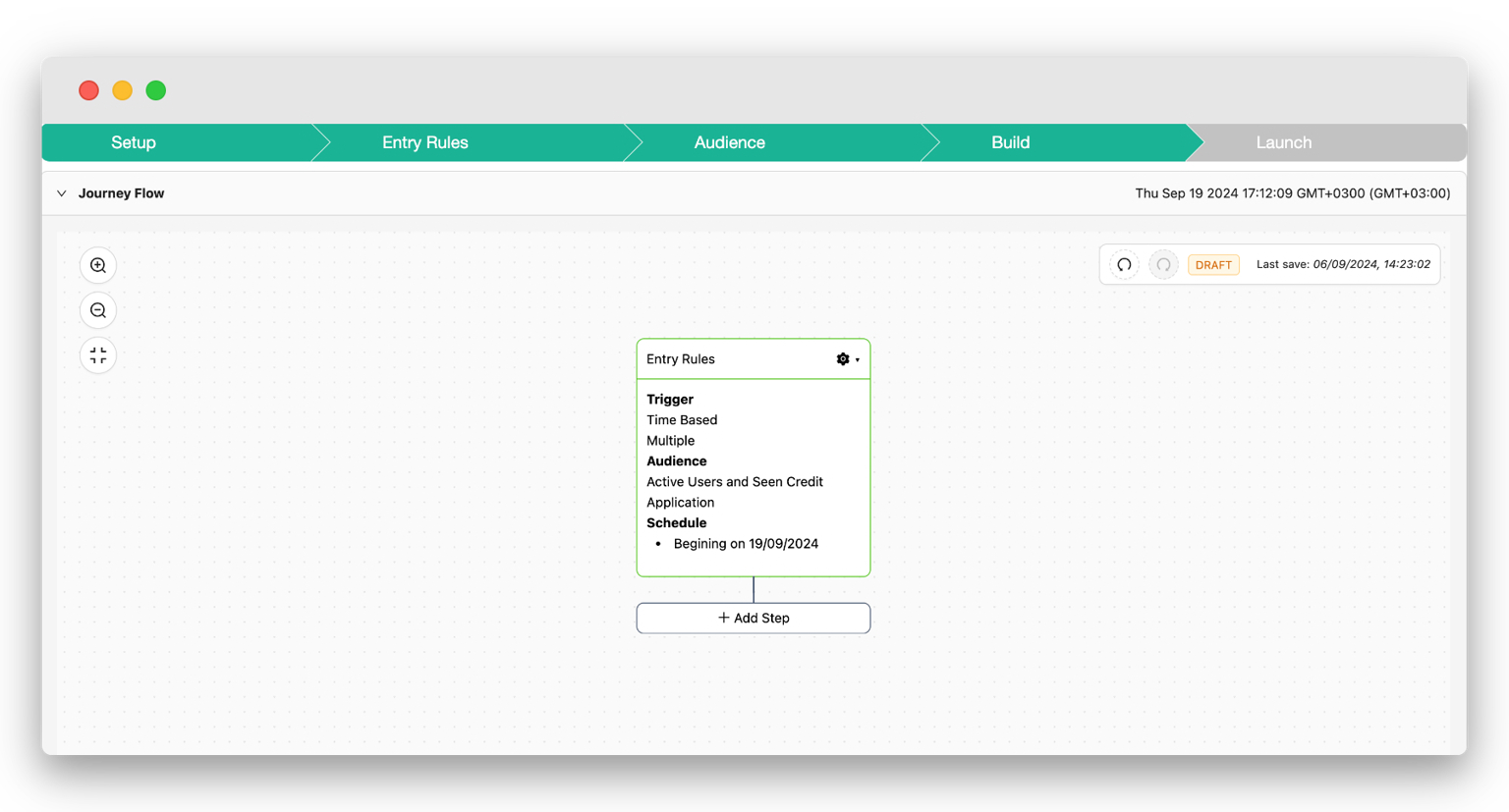
Marketers using three or more integrated channels achieve 287% higher purchase rates than single-channel campaigns. The keyword is integrated: channels that share data, respect user preferences, and respond to behavior rather than running as separate campaigns.
Mobile Commerce Statistics: Where Retention Is Won or Lost
Mobile accounts for 44.2% of all US ecommerce sales today, with total mobile ecommerce share projected to reach 59% of online retail globally. Worldpay projects that figure climbing to 64% by 2030. AppsFlyer found that 60% of first-time app buyers go on to make at least one more purchase.
These mobile commerce trends point to one thing: the app is becoming the primary purchase surface.
Customer Retention Strategies Beyond the Day 30 Wall
Global Day 30 ecommerce retention sits at 7% on average. Shopping apps hold 5%. 80% of shoppers carry three or more shopping apps on their devices. Yet, online shopping behavior data shows most downloaded apps see little meaningful use after the first month.
Ecommerce SMS marketing fills part of that gap. SMS achieves 98% open rates, with 90% of messages read within three minutes and conversion rates of 11-20% for ecommerce. Matt McFee, Managing Director at InboxMonster, puts it: “SMS is an underutilized inbox for boosting the bottom line, especially in retail.”
WhatsApp adds another high-trust layer: 98% open rates and promotional CTRs between 45-60%, with over 70% of businesses reporting improved customer satisfaction after adoption.
How a Fashion Rental Platform Turned Category Browsers into Buyers
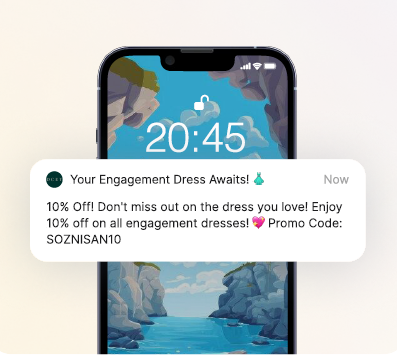
DCEY, Turkey’s fashion rental platform, had strong category traffic. Users browsed wedding and engagement dress collections regularly. Few completed a rental.
The team built a behavioral push notification that triggered 20 minutes after a user viewed the category, referencing exactly what they had browsed and including a time-limited discount. The entire flow ran automatically through Netmera, with funnel analytics tracking every step of the ecommerce sales funnel from push click to completed purchase
Conversion from category view to purchase increased 84%. Users who clicked the push converted at 9.3%, five times higher than the baseline rate before automation launched.
What Ecommerce and Retail Teams Use Netmera For
Netmera is built for marketing and product teams running customer engagement in ecommerce and retail: unified customer data, AI, omnichannel campaigns, and revenue analytics in one platform.
◈ Unified customer data: Every touchpoint, app behavior, website visits, CRM records, in-store transactions, feeds into one customer profile that reflects every interaction as it happens.
◈ Tagless Data Capture: New product category launched? Tracking starts immediately. Teams capture behavioral data from websites and apps from day one, without a developer queue.
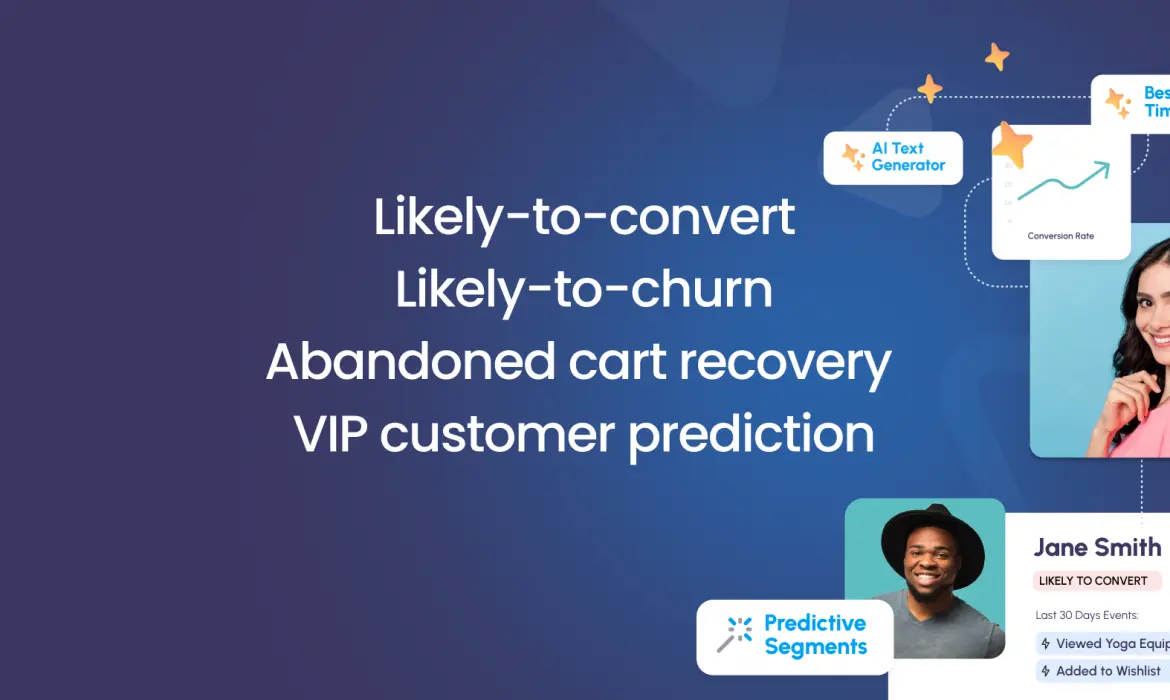
◈ Predictive AI segments: Spot the customer who is about to churn before they do. Identify who is ready to buy before they add to cart. Churn risk, purchase intent, and high-value spend models run nightly, so your campaigns reach the right people at the right stage.
◈ No-code Journey Builder: A user browses a category, leaves, and gets a push 20 minutes later; if they click but don’t convert, an SMS with a discount follows. Branching logic, frequency caps, and A/B testing are all yours to configure.
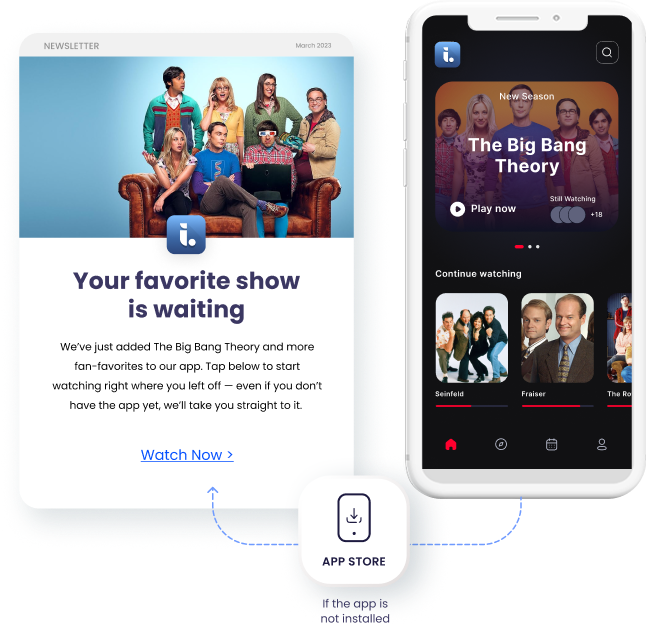
◈ Deferred Deep Linking: A user clicks your SMS campaign but hasn’t installed the app yet. They go to the app store, install, and land directly on the promoted product page.
◈ In-app engagement: Spin to Win brings users back between purchases. Surveys capture feedback at the right moment. Widgets guide users through onboarding or toward a first transaction.
◈ N-Assistant: Ask it which segment is most likely to convert this week. Describe a campaign goal and it configures the audience, channel, and timing for your review. Your team makes the call, N-Assistant handles the setup.
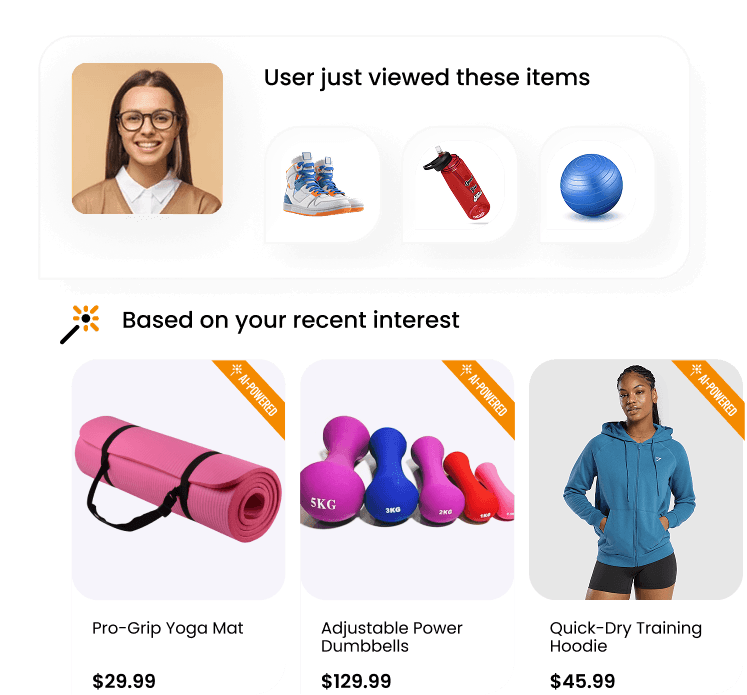
◈ AI Site Search & Browse: A shopper types “weding drss” and still finds what they came for. Category pages re-rank in real time based on each visitor’s behavior, so the products most relevant to that shopper surface first.
◈ Analytics and reporting: See where users drop off in your checkout flow, get alerted the moment conversion rates shift unexpectedly, and download reports that connect each campaign directly to revenue.
BCG projects $570 billion in incremental retail growth for personalization leaders before the decade ends. That is the ecommerce trends 2026 number worth keeping in mind. The window is open.
See how Netmera works for ecommerce and retail teams. Schedule a demo.
Frequently Asked Questions on Ecommerce Customer Engagement
Average customer retention in ecommerce sits at 25–31% annually (Shopify/Decile). Day 30 app retention is harder, with 7% for ecommerce apps, 5% for shopping apps. Repeat buyers make up just 21% of a typical customer base but drive 44% of revenue, which is why retention strategy tends to have an outsized return compared to acquisition spend.
54% of companies call personalization a top priority, but only 12% can deliver it across channels (Forrester/LiveRamp). The bottleneck is almost always data: customer behavior is scattered across apps, websites, CRM, and offline touchpoints with nothing connecting them. Teams that consolidate data first and build campaigns second tend to close that gap faster.
SMS and WhatsApp both hit 98% open rates, with SMS converting at 11–20% and WhatsApp promotional CTRs running between 45–60%. Behavior-triggered push notifications convert at 4x the rate of untriggered ones. The right channel depends on the moment in the journey: push for abandonment, WhatsApp or SMS for post-purchase, email for lifecycle.
Data fragmentation. KPMG found 74% of retailers say data management is their primary challenge in scaling AI, and only 7% have fully automated their data integration. AI tools are only as good as the data they run on, and most retail stacks are not set up to feed them cleanly.
McKinsey estimates companies that fully integrate digital and physical channels see sales grow by 20–30%. Marketers using three or more integrated channels achieve 287% higher purchase rates than single-channel campaigns (Omnisend). The caveat is that channel count alone does not drive those numbers. Channels need to share data and respond to behavior to produce results like these. Platforms like Netmera that unify data and campaign execution across channels are where teams are increasingly running this.
Mobile accounts for 44.2% of US ecommerce sales today, projected to reach 59% of global online retail. Yet Day 30 retention for shopping apps averages just 5%, and 80% of shoppers carry three or more shopping apps on their devices. The install is not the win. Retention depends on what happens in the first 30 days, and behavior-triggered messaging through channels like push and SMS is where most customer retention strategies are won or lost.
Burcu Ulucay – Content Marketing, Netmera